
Today the San Gabriel Mountains
Trailbuilders and
Mount SAC volunteers had a special
treat. Manfred brought up
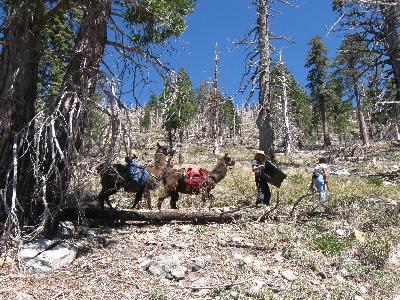
llama volunteers to enjoy
the day's exercise and take about 120 pounds of tools and equipments off
of the backs of the human volunteers, allowing the work crews to get a bit
more work done on maintaining and clearing the trail than would otherwise
be afforded.
Being the 21st of April, a great many
Earth Day projects were
taking place in the
Angeles
National Forest, from tree plantings,
San Gabriel River clean-up, to parks clean-ups and nature hikes in the
cities, all of which
meant that the U. S.
Forest Service's Gateway Information Center above
Azusa along
Highway 39
was very crowded and somewhat chaotic, prompting the
Trailbuilders to escape the
turmoil promptly at 8:00 a.m. to head north toward the Rincon Fire Station.
At Rincon the volunteers sorted through the tools and equipment that would
be needed today, checking to see how many
Mount San Antonio College students and
other volunteers would be participating in the day's effort.
Among the tools we pulled out many
McLeod's
for working the tread, metal rock bars for moving boulders and bucked
trees, three
chainsaws,
Kevlar safety chaps,
and other
personal protective equipment for the certified and safety-trained
sawyers.
Upon leaving the fire station we could look across the highway at the
Environmental
Education Center and see large numbers of volunteers gathering for other
projects, happy to see a great many young volunteers who looked to be
enthusiastic and ready to work along the cool riverbed collecting trash
and hauling it to the East Fork for collection by volunteer horses and mules.
After informing our
Angeles Dispatch safety overlords over the radio that we would be working
along
Big Cienega
Trail in the
Crystal Lake Recreation Area we packed in to our vehicles and headed
further North to Crystal Lake, to the
Deer Flats Group
Campgrounds, on to the abandoned
Mount Saint
Hawkins dirt road and there to the trailhead for
Windy Gap and
Big Cienega.
At the trailhead we had our daily safety meeting and
Job Hazard
Analysis rundown, taking a look at the local flora and fauna that we
would probably like to avoid, and stepping through some of the tools that
we would be utilizing today, making sure everyone was aware of environmental
hazards, including the need to drink lots, and lots of water since today
would be a hot one.
After the meeting we broke up in to groups, basically three groups. The
llama and their human colleagues headed up the mountain first to get a
jump on things, followed by the sawyers and swampers who would attempt
to keep up with them, and a third group of tread work volunteers who would
be fixing erosion, cutting back brush, removing growth from the trail, and
establishing rock soil retention walls along the lower sections of the
trails.
Since I was with the saw teams I had to hustle to keep up with the tools
and equipment that had not been packed on the llamas, and with the growing
heat I think I stopped at every spot of shade along the way. Since we were
relieved of about 120 pounds of equipment thanks to the llamas we were
able to get up the mountain and to the first dead tree obstruction
quickly -- which was good because by the time I had got there I had used
a third of my drinking water already, it was so hot.
From that point on the sawyers proceeded up in the mountain followed by
the llama team, removing 18 dead obstructions from the trail and finally
stopped at 13:00 which is the cut-off time according to the
Job Hazard
Analysts and
Project Activity Level
for the day. In all, 18 obstructions was a very good effort in the short
number of hours that regulations permitted for the day. That's 4.5
obstructions bucked and removed by volunteers every hour which is very
good.
From the point where we stopped cutting we could see four additional
obstructions, all of which were complete blockages of the trail such that
hikers must divert or climb under in some cases. After the fourth blockage
is the junction where Big Cienega meets up with
Islip
which goes to the
Winnona
Cutoff,
Little Jimmy
Campground, and Windy Gap Trail as well as meets up with
Angeles Crest
Highway number 2.
The last 100 feet or so were very difficult for me and my knees were wobbly
by that time, and shade is rather difficult to find at top of Big Cienega
because of the
2002 Curve Fire
that came through however one of the neat things about hiking this trail
and Windy Gap Trail is the many new pine saplings that are growing which
will some day restore the forest back to its shaded and green, cool heaven.
Hikers that went past us also paused to have their photographs taken with
the llamas, and maybe half of the hikers who paused to talk with us knew
about the Trailbuilders and the awesome work that the volunteer group does
on these trails. In this respect it continues to be a source of great
pride among Trailbuilder volunteers, the reputation of the volunteer
organization is very, very good and many of its individual members' names
are known. There's a solid sense of community, of civil service and
dedication as well as a shared love of the forest and of hiking.
After a quick lunch and downing another third of my drinking water we
started looking at heading back down to where the other volunteers were
working on the tread. The llama team joined up with the sawyers and
swampers for the hike back down which was an opportunity to observe the
llamas closeup and to be amused at how they also stopped at every spot
of shade on the way down, just like the humans did.
Also it was amusing to listen to the llamas complain about being asked to
volunteer today, they complain by grunting in long drawn-out quiet bellows
to voice their mild displeasure. Thing is, they were very lively of step,
they liked to look around and sniff the breeze as it went by, and they
were wide-eyed and enjoying the outdoor adventure by all external
appearances.
In this respect they were a lot like
Boy Scouts
who some times complain about the heat and sweat and how tired they are but
still manage to find plenty of energy to run around and throw rocks at each
other and jump on each other once back down at the trailhead. I find myself
smiling the whole way down and saw the other human volunteers also enjoying
the company of the llamas.
On the way down we got a chance to see what tread work had been done by
the other volunteers, long tracts of trail that had the Yerba Santa removed,
brush cut way back, water-caused runnels filled in and repaired, drainage
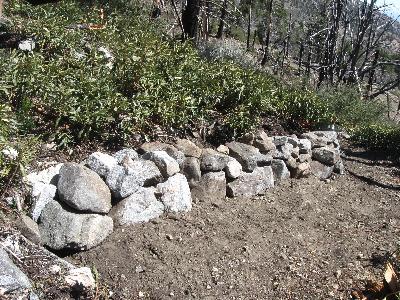
improved, and an awesome rock wall for soil retention had been added!
Looked great!
When the llama and sawyer teams reached the trailhead we found that
everyone else had already left since we were somewhat late for the rally
point time of 15:30 and, using the radios, we confirmed that we would be
late.
Eventually Trailbuilder Ben came back to the trailhead in a vehicle and
picked the rest of us up, saying goodbye to the wonderful llama volunteers,
and spiriting us away back to Runcon where we examined and stored our tools
away until next time.
This one was a very enjoyable day out volunteering in the forest and the
first actual hot and sweaty one of the year. During the day a great many
volunteers worked throughout the forest planting trees, collecting and
hauling trash, picking up litter, recycling what they cleaned up where
possible, and generally lending a hand not only in the mountains but
also in the parks down in the cities.
After storing the tools we headed back down the mountain and back to the
Gateway Information Center where I opened the pickup's door, stepped out
of the cab, and fell flat on my face since my legs refused to work. LOL!
Man, what a day!
 Llamas at the trailhead for Big Conega and Windy Gap
 Volunteers staging up at the trailhead
 Volunteers wlaking up South Mount Hawkins Road to the trailhead
 Along Big Cienega Trail there is a stream crossing the trail
 Lots of water! Good to cool off in!
 Llamas in the distance, hiking up the mountain
 The sawyers catch up with the llama team
 The first obstruction is a small one. The small 16 inch saw takes care of it
 The next obstruction is a root ball and a blockage
 The two obstructions after that are much larger. Swampers stand ready also
 A look at what's coming up next
 One of the obstructions has a cut in it already from years ago
 Trailbuilder Tom pushes and shoves a bucked section of tree trunk
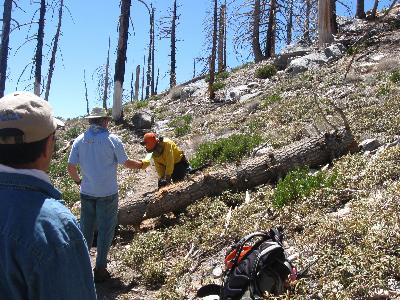
 As the bucked section is removed, the swampers work the tread
 As another obstruction is carefully bucked, swamper offers a wedge
 After 18 obstructions are removed, it's time for water! And lunch
 The llama team reaches the saw team
 Another look at the Windy Gap Saddle off in the distance
 Time for the llamas to pause and have lunch and rest also
 Some of the brush the llamas seemed to enjoy eating
 This is the next obstruction that must be bucked and cleaned off of the trail
 The obstruction after that one should be fairly easy and straight forward
 More obstructions along the trail just after that one
 One of the llamas decides to lay down and take a nap
 The other llama joins in the nap
 A look at the many limbs on the next obstruction
 The rock retaining wall that's gone in at the lower elevations
This web site is not operated or maintained by the US Forest Service, and
the USFS does not have any responsibility for the contents of any page
provided on the http://CrystalLake.Name/ web site. Also this web site is
not connected in any way with any of the volunteer organizations that are
mentioned in various web pages, including the
San Gabriel Mountains
Trailbuilders (SGMTBs) or the
Angeles Volunteers Association
(AVA.) This web site is privately owned and operated.
Please note that information on this web page may be inaccurate.