
Today the
Trailbuilders returned to the
East
Fork Trail of the
San
Gabriel River located within the
Angeles National
Forest.
Today's goals were numerous, a list of tasks that needed to be accomplished
was acquired the Saturday previous after a formal survey of trail conditions
by Trailbuilders volunteers.
Today we had members of the
California
Conservation Corps and students from
Mount San
Antonio College join the effort which was greatly appreciated since
there was no possible way that the Trailbuilder volunteers could have
accomplished the work load slated for today.
In all we had 28 volunteers working the day's tasks, splitting up in to two
groups so that the wooden steps at the trailhead and the erosion problem
could be fixed while at the same time the larger team spread out along the
trail to wrest boulders out of the way and to shovel off rock slides.
One of the wonderful think about getting younger volunteers to join such
efforts is that the older volunteers can point at 800 pound boulders and
suggest it be moved, then step out of the way and relax while the younger
volunteers do it. :) LOL It sure helps muh poor back when trail
work consists of supervising. :)
But that was what I personally did most of the day, basically provided
safety oversight because working around the cliff face and the river
crossings, the experienced Trailbuilders often do nothing but safety
oversight and make sure that everyone has their protective clothes and
equipment on and that everyone has something to do. The rock cliff face
that is still coming down (however slowly) constitutes a significant
safety hazard and thus significant safety oversight, so that's what I
did most of the day. Easy on my poor back!
One portion of the trail has seen serious hillside movement which caused
rock and dirt to encroach on to the trail, forcing hikers to walk on the
slope and re-establish the trail on top of the slope. For that area we
brought down the hillside, re-built the trail back in to its original
location, and filled in sections with rock and sand so that what had
previously been high step-up areas were now short steps, often with an
inclined slope.
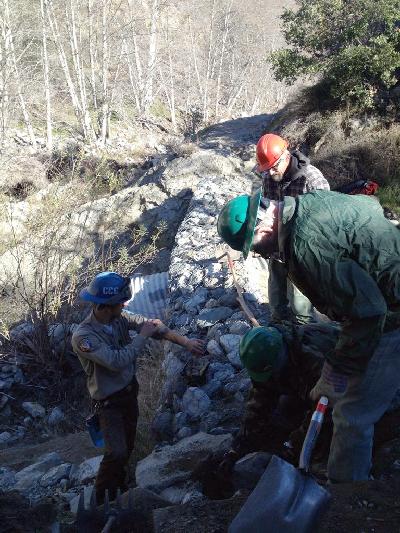
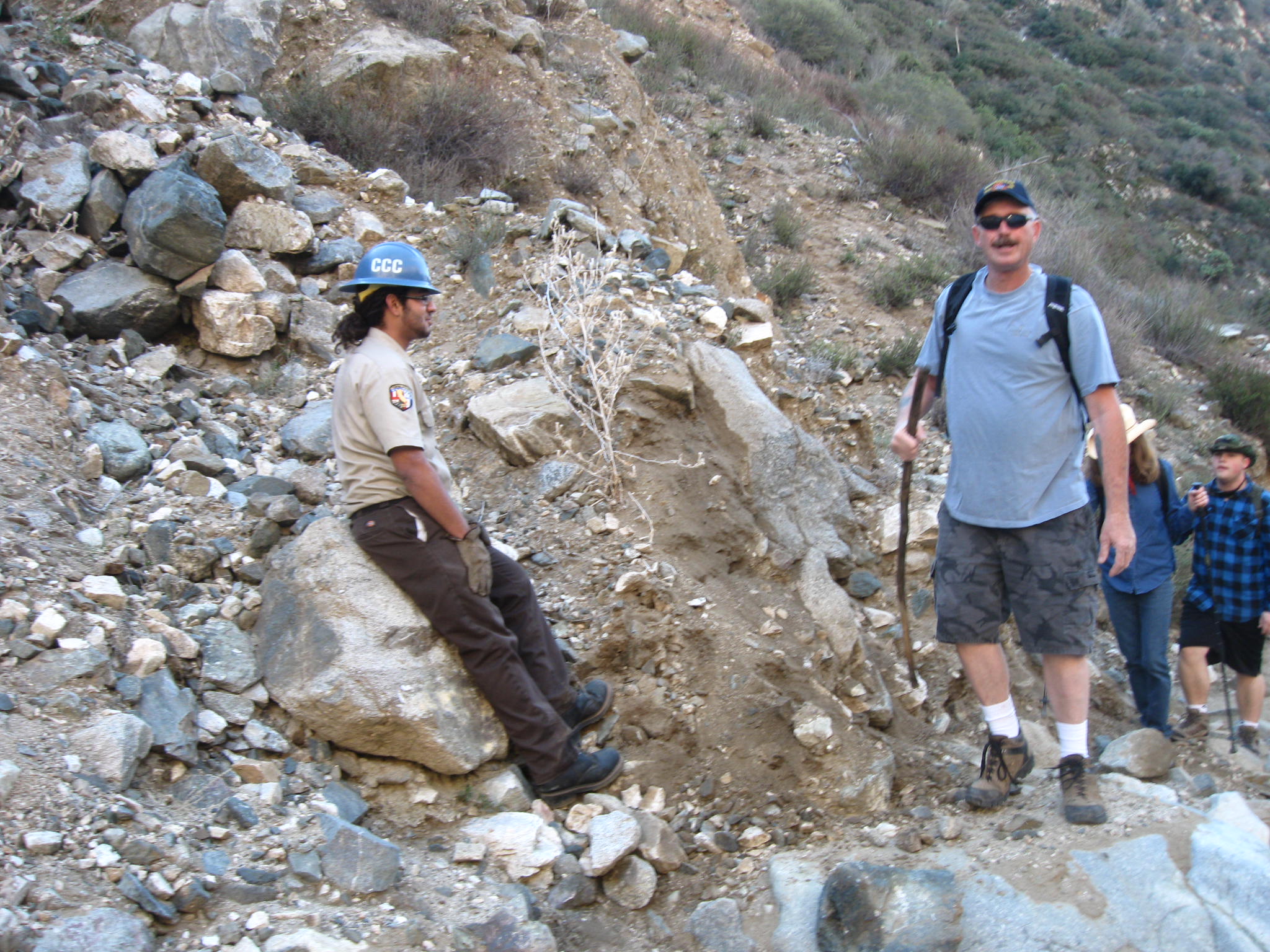
The California Conservation Corps was awesome, from the moment their tools
hit the trail they were always at work, I don't think they even stopped for
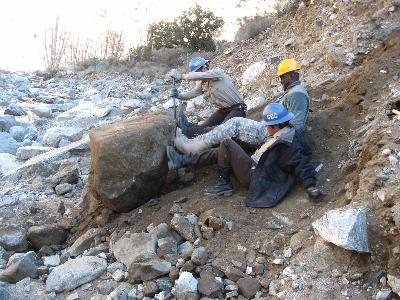
lunch but I'm not sure. There were a number of very large boulders that
needed to be moved and the CCC members had enough people who could shove
boulders out of the way that it was done despite the difficulty involved
when rigging equipment does not get carried to the field.
The San Antonio College students spent a great deal of effort working on
a section of the trail that was getting a new retaining rock wall built
and rock and sand moved to fill in behind it, and to fill in a very large
step-up. Many buckets of sand were filled and dumped. Good exercise! Makes
my arms sore just watching, though.
The crews working on the wood steps and erosion along the trailhead met up
with the group working on the trail section getting filled in with rock and
sand, and when that effort was almost completed, most volunteers continued
on the trail removing boulders along the way until getting to the cliff
face that had come down.
Previously the Trailbuilders had flagged the rock pile which by my
calculations (however wide my error bars) is about 4 million pounds of
boulders. It is a BIG boulder pile, and there is a cornice overhang
that still needs to come down and maybe another million pounds of rock on
the cliff face that needs to come down.
Because of water freezing to ice and expanding behind the rock, eventually
all of that will come down and add to the pile currently covering the trail,
so we had previously flagged it and blocked off access to keep people from
climbing over the top. Well, someone removed the work that we did, allowing
people to climb over the top of the pile which is not very safe.
So today we blocked off both ends of the rock pile, doing so with a great
deal of rock and dead tree limbs and trunks. We also placed warning signs
asking hikers to cross the river twice more while we're in the process of
solving the problem.
At the same time two new river crossings were established with boulders
being moved, dead tree trunks being laid, and foot paths going to the
crossings being established. On the far side of the river another 50 feet
or so of new trail was established connecting the two river crossings.
The crossings themselves are temporary, the tree trunks that careful hikers
can use to assist in crossing (if the don't want to get their feet wet
again!) will not last very long. The first heavy rain that comes through
should see much of the tree trunks get moved about, so this is a temporary
solution to a much more difficult problem.
What we have here is a section of the trail where a cliff face has come down
and covered the trail. Two problems now exist. (1) More rock is going to come
down over time constituting a safety hazard on top of the usual safety
hazards always assumed when hiking in the forest and (2) It would be about
18 months for volunteers to remove the rock to uncover the trail.
A solution is to blast the cornice overhand and cliff face to proactively
bring down all the rock that is going to come down, then use expansion
compounds and more explosives to break apart the larger boulders on the
ground, then use rigging to drag it all away, spreading it around, uncovering
the trail and re-establishing the trail's original path,
Another solution is to leave the rock pile as it 8is, haul over some of the
moulders and create a raised trail section that rounds the rock pile,
filling it all in with rock and sand so that even high water runs will not
wash it away. And that's perfectly doable and reasonable, not mention take
less time than 18 months.
Only the problem with the second solution is that it still leaves the need
to blast to bring down the rock so that people walking the new proposed
raised trail loop won't be hit by flying rock as more of the cliff face
comes down naturally.
The professional geologists and the
Forest
Service are looking at solutions, as are the engineer professionals with
the Trailbuilders.
A serious solution needs to be implemented because this hike is a very
popular one, the trail is well loved. Whatever solution is decided upon,
more volunteers will be asked to join the effort and hopefully Mount San
Antonio College will send more helping hands, and hopefully the California
Conservation Corps will continue to assist with this much loved trail.
Eventually the new crossings were completed, all of the tools and equipment
were collected, and we paused to take one last look at how well the route
over the rock pile was blocked off. There is no way to stop people from
climbing over and through safety hazards, all that can be done is try to
discourage people from doing so which is what we accomplished.
One the way back to the trailhead we encountered two additional tasks that
needed to be done. There is a bit of a climb on the far side of the river
after which a narrow section of trail has been eroding. While some volunteers
worked on moving boulders to establish a rock retaining wall and to fill that
in, the rest continued on toward the trailhead and moved one last large
boulder off of the trail, then continued on to the trailhead.
While we waited for all volunteers to come in, we broke apart illegal fire
rings at Heaton Flats and used our
McLeod tools
to rake the ash in an effort ti discourage people from setting illegal
ground fires.
After that we were done for the day! Everything got accomplished which is
always very satisfying. We returned to the Rincon Fire Station, inspected
and put away our tools, and a fun time was had by all!
 CCC and San Antonio College students filling in along rocks
 One of the new temporary river crossings
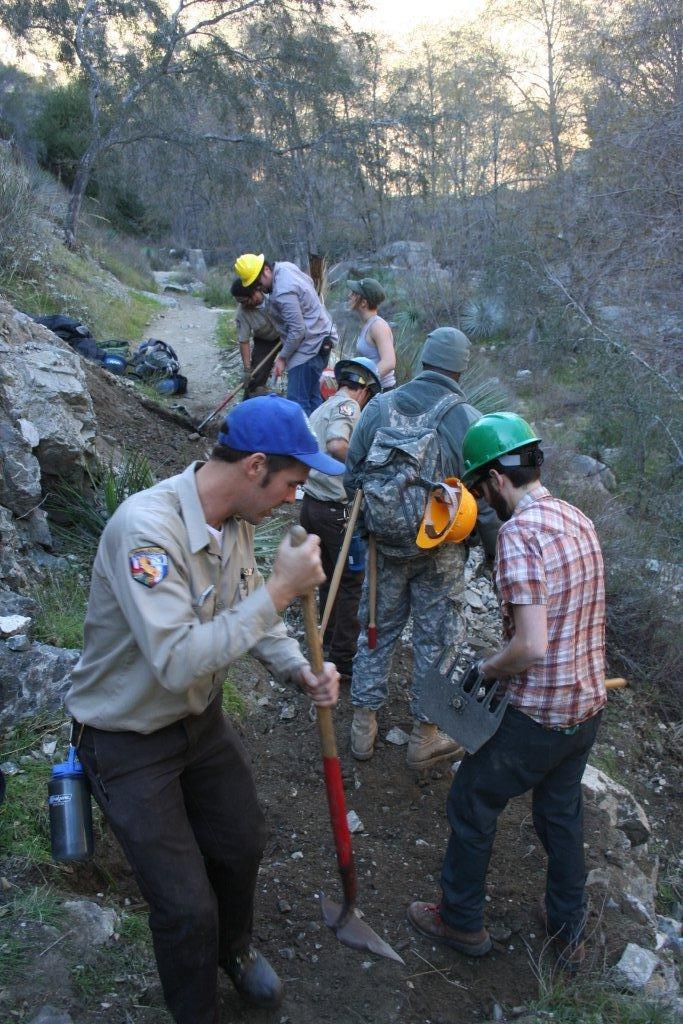 Finishing a section filled in and re-established
 CCC and Trailbuilders Joshua
 Fill being taken from the river bed and then the river bed is cleaned up
 Access through the cliff face boulder pile has been blocked off
 Volunteers working on establishing the trail on the far side of the river
 A look at the river during low tide :)
 At the end of the day returning to the trailhead
 Hiukers cross one of the new temporary river crossings
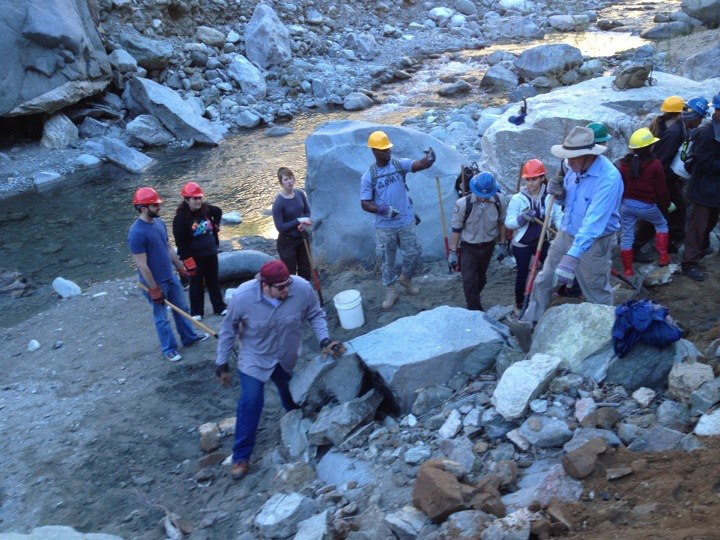
 Meeting at Heaton Flats for the daily JHA safety meeting
 Meeting at Heaton Flats for the daily JHA safety meeting
 Meeting at Heaton Flats for the daily JHA safety meeting
 Meeting at Heaton Flats for the daily JHA safety meeting
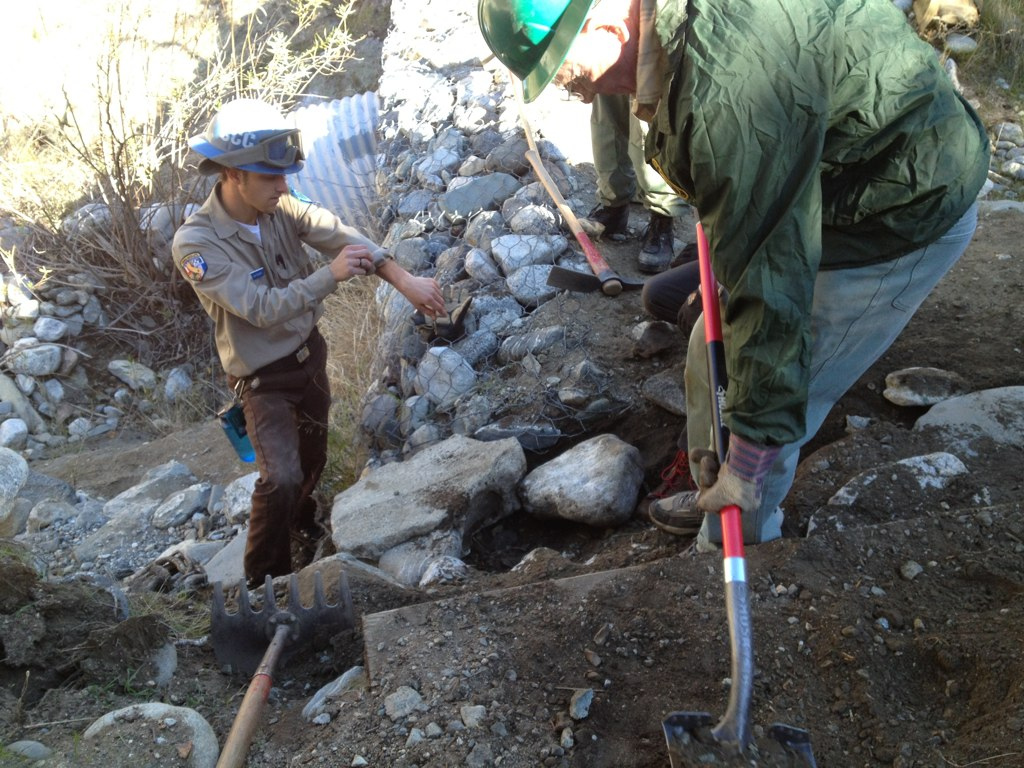 Working on the wood steps and the erosion at the trailhead
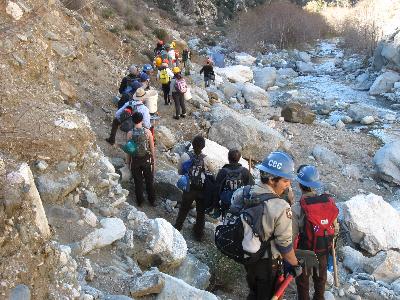
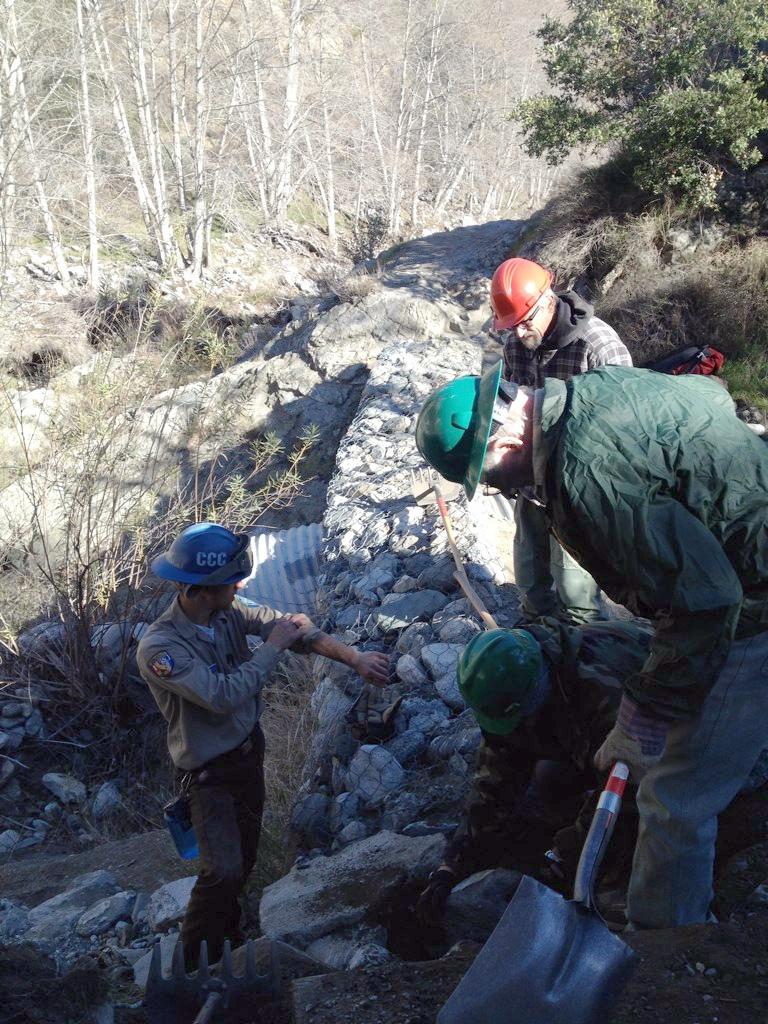 Volunteers on the trail
 A look up a side canyon where water usually comes down
 Back at the first major effort filling in the trail
 Back at the first major effort filling in the trail
 Back at the first major effort filling in the trail
 CCC carrying in boulders for the soil retaining wall
 Back at the first major effort filling in the trail
 A wider look at the first major work effort for the day
 At the cliff face on the first approach
 View from across the river at the volunteers working near the cliff face
 Volunteers crossing one of the new temporary river crossings
 Hikers crossing one of the new temporary river crossings
 View from across the river at the volunteers working near the cliff face
 A look at the rover and the rock on the far side
 One very large boulder that came out of nowhere :)
 Volunteers sitting under the large boulder
 Two of the CCC crews sitting on the boulder they're about to move
 Lots of hikers came out today, it was almost like Summer
 Some of the trail on the way to the cliff face
 Volunteers walking on the trail
 Back at the first major effort filling in the trail
 Back at the first major effort filling in the trail
 Back at the first major effort filling in the trail
 A look at the river
 I work with two CCC crews to bring down the hillside and restore the trail
 I work with two CCC crews to bring down the hillside and restore the trail
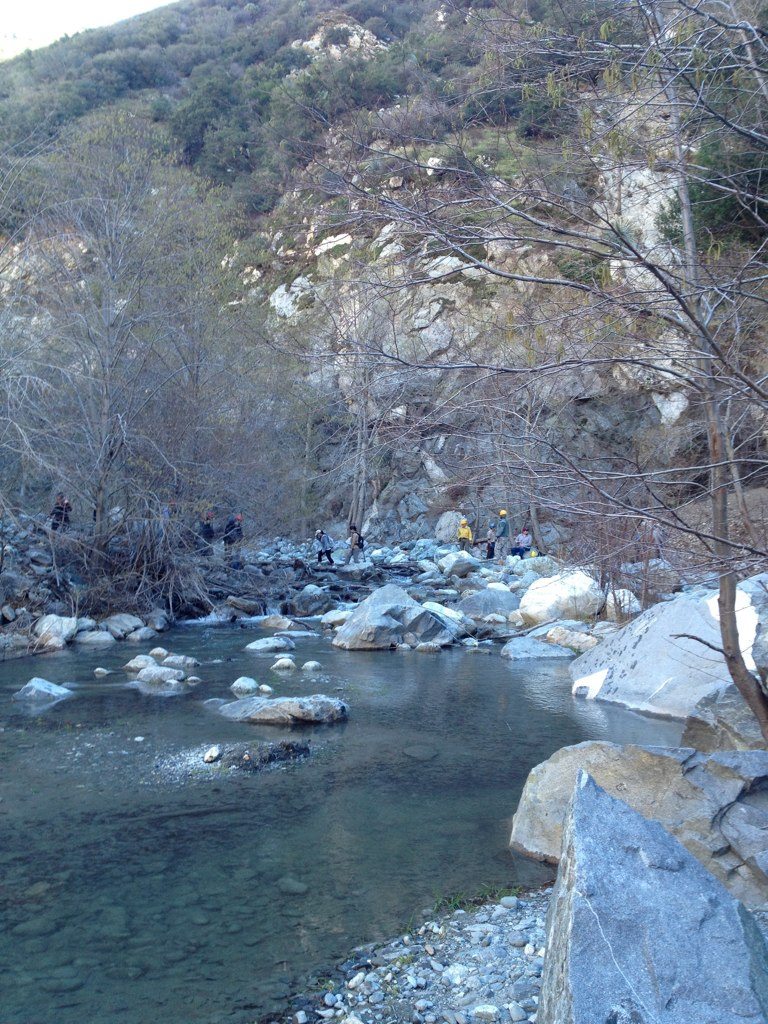 Across the river volunteers work on establishing the new trail segment
 Volunteers cross one of the new temporary river crossings
 Part of the new trail that affords access to the first new river crossing
 Another look at how the first use trail through the boulders was blocked off
 Another look at the volunteers working on the cliff face side of the river
 At the end of the day hiking back to the trailhead
 At the end of the day hiking back to the trailhead
 Volunteers sitting under the big boulder
 You can kind of see how the area becomes a meadow in some places
 A good look at the plants and the river of the canyon
 A look at the section of the trail created on the far side of the river
 A look at the section of the trail created on the far side of the river
 On the hike back, a point where people's feet still get wet
 On the hike back, a point where people's feet still get wet
 Safety meeting at Heaton Flats, different camera used this time
 Moving boulders from the trail on the way
 Moving boulders from the trail on the way
 Moving boulders from the trail on the way
 Hillside bring brought down so the trail can be re-established
 Hillside bring brought down so the trail can be re-established
 Boulders being moved off of the trail, fill being brought in
 More fill brought in
 Many buckets of sand and dirt were brought in to level the trail here
 A good look at the effort, you can see how much of the hillside was brought down
 Sand was taken from the river bed and then the river was cleaned up
 Good look at the effort and how well the fill went
 Hiker asks if I would take his photograph!
 Another good look at the effort, see how much dirt brought down
 The sand here is about 2 feet deep
 Meanwhile a major boulder still needs to br shoved out of the way
 We call in for some heavy backup :)
 This boulder is stubborn but eventually goes over
 Just needs a little more effort
 Done! The boulder has been removed, time to rest just a bit
 Trailbuilder Bob examines the lay of the trail next to the river
 The riverbed gets dressed up, San Antonio College students!
 The trail section wher ethe huge boulder was removed gets cleaned up
 Signs get posted on the approach to the cliff face boulder field
 Access to the boulder pile gets blocked off in a number of places
 Hikers cross the river
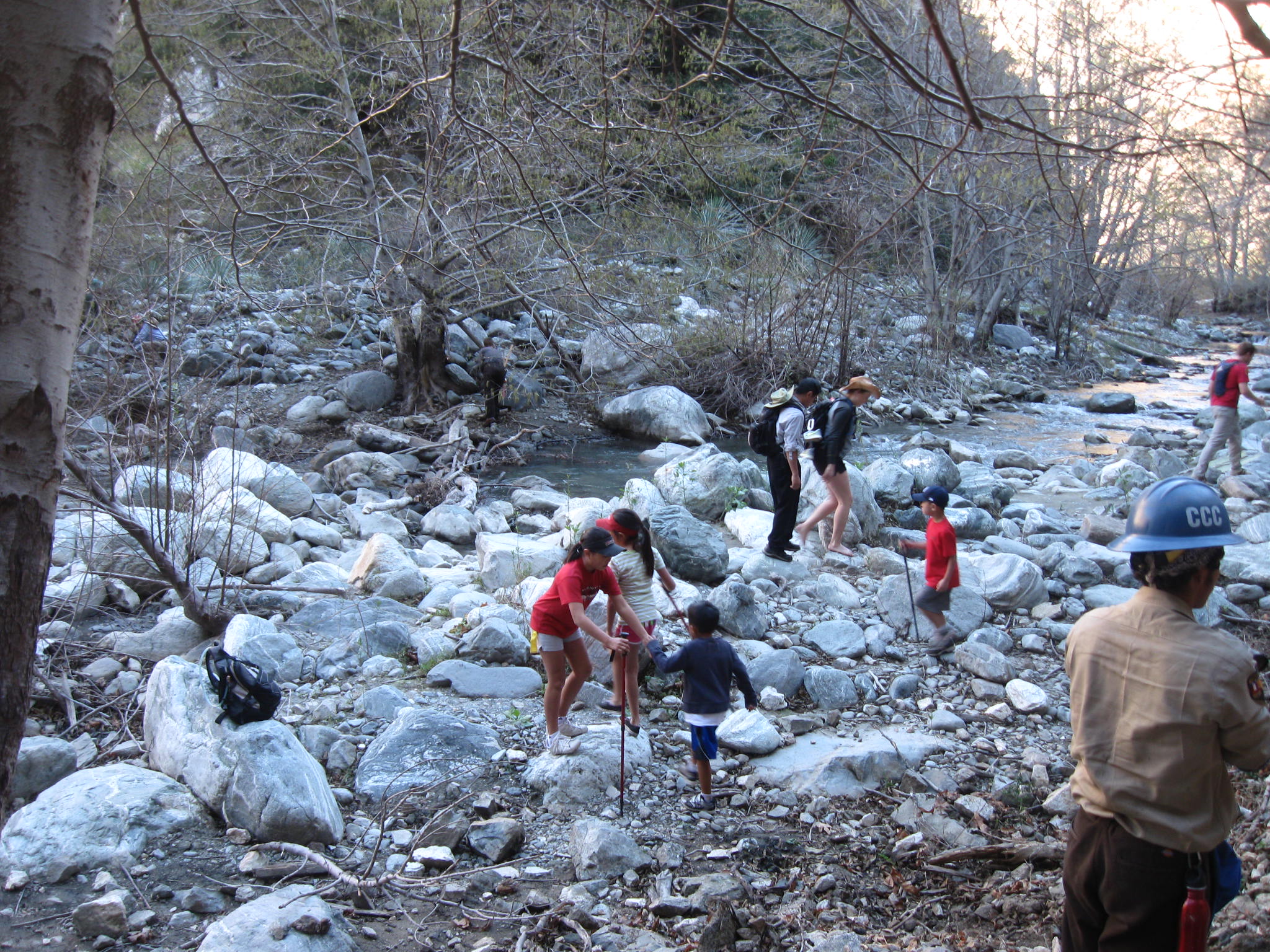 Hikers cross the river
 More blocking is done and the trail turns right to cross the river
 The second new temporary river crossing, mostly rock and dead trees
 A section of the new trail on the far side of the river
 A section of the new trail on the far side of the river
 A section of the new trail on the far side of the river
 A section of the new trail on the far side of the river
 A better look at the first new temporary river crossing
 A better look at the first new temporary river crossing
 The two new crossings means that most people will get a little wet
 Another look at the dry crossing that was added at one of the approaches
 Another look at the dry crossing that was added at one of the approaches
 Another look at the dry crossing that was added at one of the approaches
 At the cliff face the volunteers pause to get everyone together again
 People fishing along the river, actually catching fish!
 Volunteers hiking back to the trailhead at the end of the day
 Volunteers hiking back to the trailhead at the end of the day
 Another look at the boulder I tried to help with :)
This web site is not operated or maintained by the US Forest Service, and
the USFS does not have any responsibility for the contents of any page
provided on the http://CrystalLake.Name/ web site. Also this web site is
not connected in any way with any of the volunteer organizations that are
mentioned in various web pages, including the
San Gabriel Mountains
Trailbuilders (SGMTBs) or the
Angeles Volunteers Association
(AVA.) This web site is privately owned and operated.
Please note that information on this web page may be inaccurate.