
Today the
San Gabriel Mountains Trailbuilders
returned to
Windy Gap Trail
to start repairing the damaged
Sutter Walls
which a paid contractor installed along the trail about 9 years ago.
Normally the walls themselves do not fail, the walls are well designed,
the heavy metal uprights and the treated horizontal wood used for the retaining
walls usually rarely fail however the anchors that the contractor applied
for all 12 walls was something less than hearty enough to hold the
catastrophic loading that one of the walls encountered, and the incremental
loading that two other walls experienced, so three walls have been damaged
over the years.
The Windy Gap Trail is one of the most-loved trails within the
Crystal
Lake Recreation Area, it affords a fairly short (about 2.5 miles) hike
from approximately 6500 feet altitude at the campgrounds below, up to Windy
Gap Saddle at 7582 feet, so while parts are fairly steep, it's a short enough
hike that fatigue isn't really a problem.
Windy Gap Saddle itself affords access to
Vincent Gap,
Mount Baden-Powell,
Little
Jimmy Trail Camp,
Mount Islip,
and because the saddle itself is part of the
Pacific Crest
Trail, the Saddle is a jumping-off point for the entire 2663 miles of
the trail, so hikers confronted with the trail signs at the Saddle may choose
to head South toward
Mexico, or North toward
Canada.
And what a great day out it was, too! The weather could not have been better,
it was fairly cool and cloudy down in the cities below yet passing through
3000 feet altitude we broke out in to Sunshine even as the temperature
continued to drop the higher we got up the mountain.
Upon reaching the trailhead along
South Mount
Hawkins Road, the Trailbuilders had the daily
Job Hazard Analysis
review, a safety meeting which touched upon the tools and equipment we
would be using today, and touched upon the flora and fauna within the
region we would be working which we might wish to avoid. The
Southern
Pacific Rattler
is common to the area and every year people get bit, plus there are
scorpions and ticks to
avoid! Fun!
After the safety meeting and a review of the
Project
Activity Level for the day, we broke up and headed up the trail. Since
this was a repair day and also a survey day, I took photographs of all of
the Sutter Walls along the trail, the damaged ones as well as the healthy
ones, and acquired the GPS coordinates for all of the walls.
To ensure I got all of the walls, I hiked all the way to the Saddle and took
a short nap on the couch that we carved out of a long pine tree up there,
amusing some of the many hikers and trail runners that came through. To
make sure nobody thought I was sleeping on the job I assured them that I'm
a volunteer who gets paid in
jalapeno peppers and
avocados, not tax dollars.
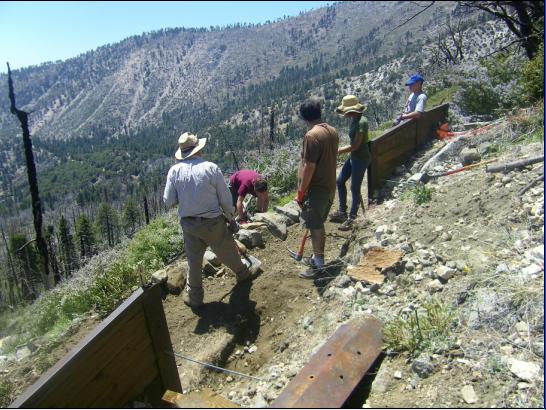
While I was shoveling rock slide off of the trail while working my way up
to the Saddle, the other volunteers were working on the trail tread, removing
tons of rock along the trail and also working to excavate several destroyed
sections of the second wall whose anchorage had failed. In order to replace
the wall section, all of the rock and dirt behind the wall needs to be
removed, and that is literally tons of material for some of the sections
of retaining wall.
After leaving the Saddle I worked my way down the trail, and got to the
second major destroyed wall, then started to excavate the materials that
had buried one of the sections. Here, hikers had established their own
trail to bypass the destroyed section, yet parts of the metal uprights
and metal caps for the wall were sticking out, something of a minor
scratching hazard that could tear people's pants.
Excavating the rubble from off of the wall was a major effort since some
of the boulders resting on the wall were hundreds of pounds. When working
on bringing materials down off of a steep slope like had to be done here,
one must work to the side of the materials one is bringing down, which
means that all of the force being applied to bring the materials down
safely and to wrest the debris off of the trail is done at a less-than-optimal
angle -- which can be tiring.
Trailbuilder Alan worked on that excavation effort, then Trailbuilders
Victor, Bernie, and Ben hiked up to join the excavation effort and to
evaluate the short term and the long term repairs that were needed on the
wall.
Eventually we were able to uncover a section of the destroyed wall, remove
it from the trail, and then continue the excavation of the trail itself,
re-establishing the tread so that hikers don't need to go around any more.
We successfully removed the metal laying horizontally whgich could possibly
rip clothing, and stacked the wall fragments mostly neatly along the
up-slope of the trail.
Because this wall is within a major rock chute, and because we're not
usually allowed to use
explosives
to bring down all the rock proactively, this wall will continue to have
boulders come down, so rather than replace the destroyed sections with
new Sutter Walls, for now it seems we will restore soil retention using
rock walls. There's plenty of large boulders we can use, and as each section
gets destroyed we can simply excavate and rebuild a new wall, otherwise
we'll have to repeat the expense of putting in Sutter Walls -- which look
nice but can be expected to be repeatedly buried at this part of the trail.
Hiking back down to where the other major effort was taking place, I was
amazed to see that the other volunteers had fully excavated two sections
of the other wall, getting all the way down to dirt at the level of the
trail tread. I had thought that perhaps half of the materials behind the
wall could be removed, prompting the need to return for a second day however
the volunteers were able to get everything removed in one go.
In all, it was a very successful day, the main objectives had been achieved
and we have a good idea of what the job effort will be the next time we come
up and continue to repair the trail along the rock chute.
It is always a privilege to be allowed to work like this in the
Angeles
National Forest, the
U. S.
Forest Service provides us volunteers with annual training in a wide
variety of things which assists volunteers in performing much-needed
recreational work in a National Forest which has seen its budget cut
repeatedly, paid employees laid off, and an ever-increasing difficulty in
maintaining and administering the public lands.
How better to enjoy the outdoors and to get heavy exercise while improving
recreation opportunities on the land that we all own than to volunteer to
work the trails, staff the Visitor Centers, collect and haul trash, swamp
out toilets, scrap off spray paint, assist with medical emergencies, patrol
for smoke and fire, lead hikes for school children, all the rest of the many
things that unpaid volunteers do every day in the forest?
Higher resolution photographs of Sutter Wall #5 Repairs
Survey of trail signs at the Windy Gap Saddle
Survey of all 12 Sutter Walls
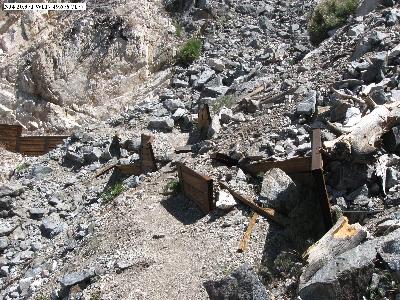
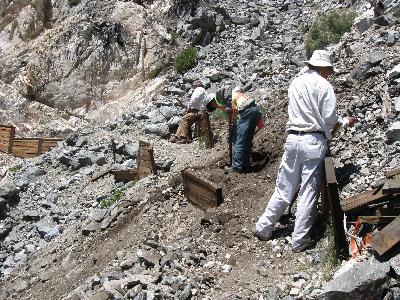
 Sutter Wall #7 gets excavated
 Almost finish with Sutter Wall #7
 The damaged wall sections get stacked up out of the way
 Many hikers waiting for us to get out of the way
 The finished trail tread at wall #7
 At the end of the way we gather back on South Mount Hawkins Road
 Excavating behind the Sutter Wall
 Excavating behind the Sutter Wall
 Excavating behind the Sutter Wall
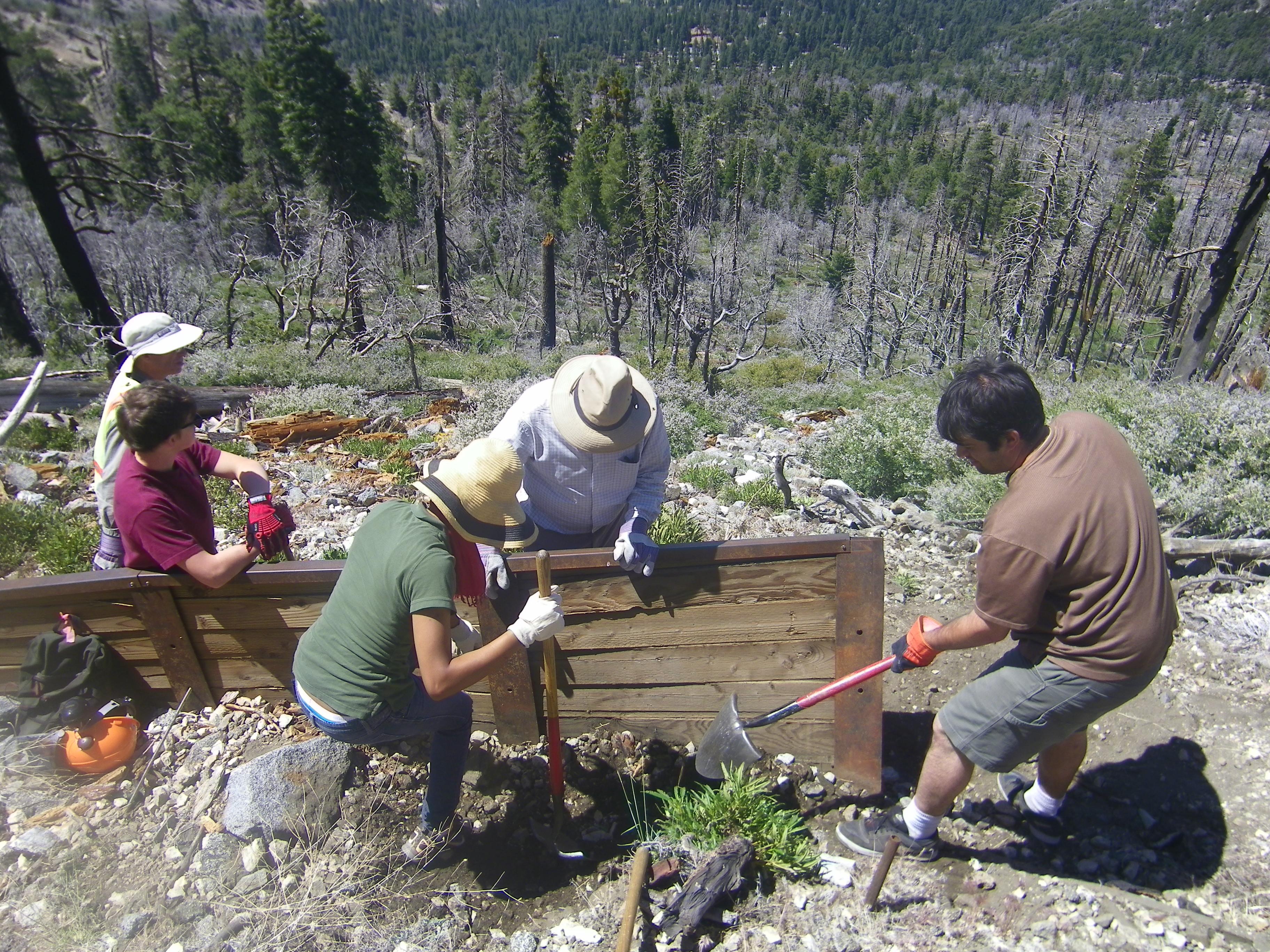 Excavating behind the Sutter Wall
 Excavating behind the Sutter Wall
 Excavating behind the Sutter Wall
 Excavating behind the Sutter Wall
 The corner of Sutter Wall #5 fully excavated, still bent outward
 TYhe corner of the wall needs to be pulled in to shape
 Corner of the wall continues to be worked on
 Corner of the wall continues to be worked on
 Corner of the wall continues to be worked on
 Excavating behind the larger section of the wall
 Much of the dirt also needs to be removed for new anchors later
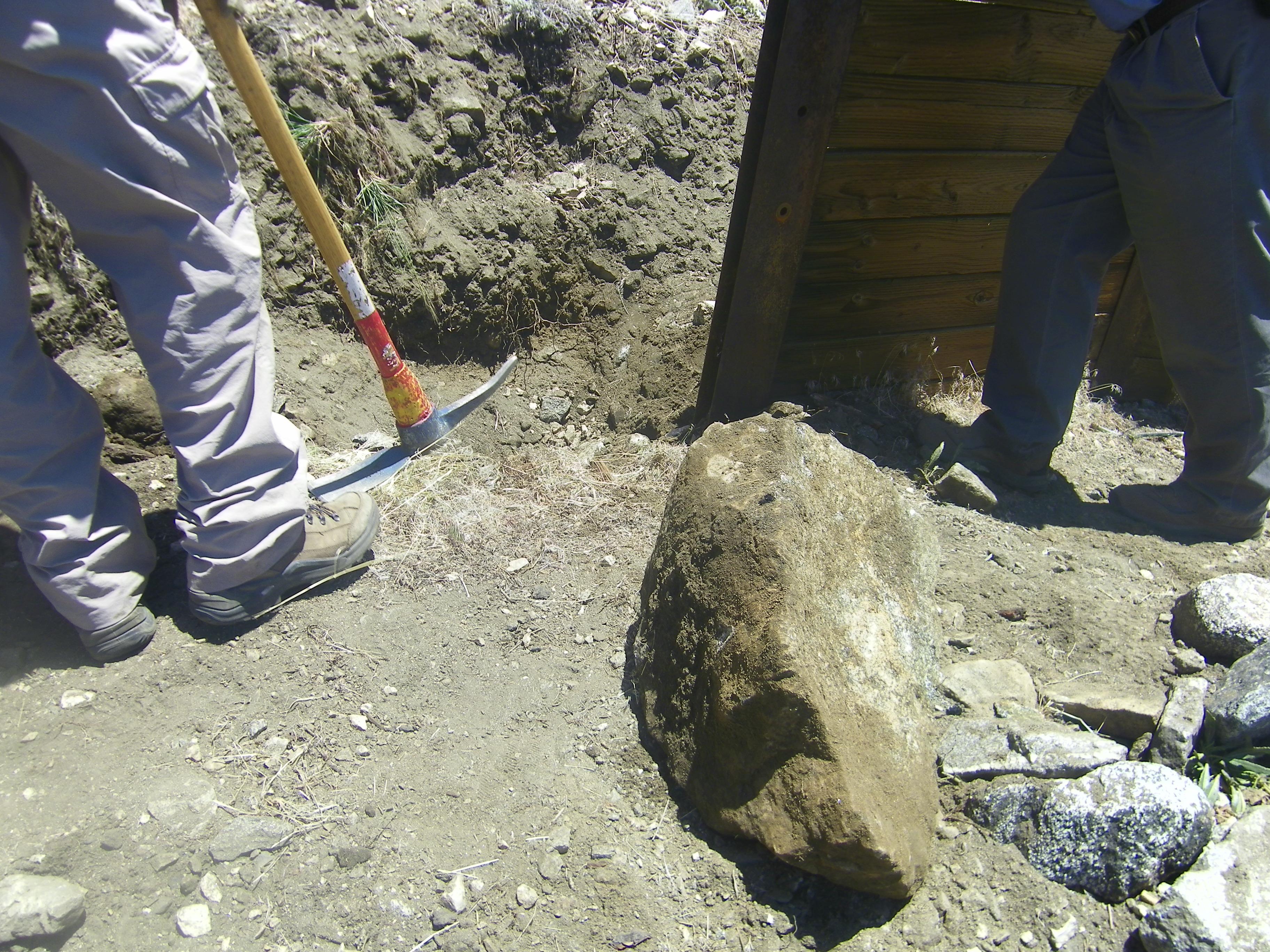 Rocks set aside for the other side of the trail tread for a retaining wall
 Fully exvacated
 We get a first look at the entirely wall section having been removed
 Across from the wall a rock retaining wall gets established
 Across from the wall a rock retaining wall gets established
 Across from the wall a rock retaining wall gets established
 The destroyed sections of the Sutter Wall gets stacked neatly
 Across from the wall a rock retaining wall gets established
 More rocks are stacked for the rock wall going in
 More rocks are stacked for the rock wall going in
 More rocks are stacked for the rock wall going in
 More rocks are stacked for the rock wall going in
 Some of the flowering plants along Windy Gap
 Wall fragments get stored behind the wall
 The long section of the wall having been removed completly
 Removed wall section and new rock wall
 Removed wall section and new rock wall
 Removed wall section and new rock wall
 A look at the rock retaining wall from behind the Sutter Wall
 Looking across the San Gabriel valley from Windy Gap
 Resting on Windy Gap Saddle
 New pine trees at Windy Gap Saddle
 The mile post 2 here needs to be re-planted
 Sign photograph 1
 Sign photograph 1
 Sign photograph 3
 Sign photograph 4
 Sign photograph 5
 Sign photograph 6
 Sutter Wall #1
 Sutter Wall #2
 Sutter Wall #3
 Sutter Wall #4
 Sutter Wall #5
 Sutter Wall #6
 Sutter Wall #7
 Sutter Wall #7
 Sutter Wall #7
 Sutter Wall #7
 Sutter Wall #7
 Sutter Wall #7
 Sutter Wall #7
 Sutter Wall #7
 Sutter Wall #7
 Sutter Wall #7
 Sutter Wall #8
 Sutter Wall #9
 Sutter Wall #10
 Sutter Wall #11
 Sutter Wall #12
This web site is not operated or maintained by the US Forest Service, and
the USFS does not have any responsibility for the contents of any page
provided on the http://CrystalLake.Name/ web site. Also this web site is
not connected in any way with any of the volunteer organizations that are
mentioned in various web pages, including the
San Gabriel Mountains
Trailbuilders (SGMTBs) or the
Angeles Volunteers Association
(AVA.) This web site is privately owned and operated.
Please note that information on this web page may be inaccurate.