
Today a number of the San
Gabriel Mountains Trailbuilders turned out with the
Del Rosa Hot Shots to refresh our
chainsaw safety training
and certifications, an annual effort which ensures that the volunteers are
safe in the field while clearing downed trees across the hiking trails
that are our responsibility in the
Angeles
National Forest of the
San Gabriel
Mountains.
And what fun it was, too! Among the volunteers who were getting refreshed
were members of the awesome
Pacific Crest Trail Association (PCTA)
which also utilize chainsaws and
crosscut saws in
the unpaid volunteer work involved in clearing, maintaining, and re-opening
hiking trails.
The previous day was spent working in a classroom with 24 other students
going through the safety rules and regulations that the
U. S.
Forest Service require that all fielded employees and volunteers must
follow for maximum safety. In addition to the safety training in the
classroom we also got formalized instruction of best practices which reduce
fatigue and thus improve our safety.
The course material was systematic and very informative, consisting of
materials that the experienced volunteers see every year but updated to
include changes in policies and procedures and changes in technology and
materials for the tools, equipment,
personal
protective clothing and other aspects of safe chainsaw use in the
mountains.
There were other organizations represented among the volunteers getting
their training though I did not make a list.
The Pacific Crest Trail Association is the volunteer organization that
takes a proactive and leadership role in maintaining the 2,600+ mile-long
hiking trail that runs through California, starting in Mexico and ending
in Canada (unless of course you hike the other direction!) Locally the
PCTA tackles the segments of the trail that run through the San Gabriel
Mountains which overlook the
Crystal
Lake Recreation Area, so the Trailbuilders and PCTA volunteers at times
mingle (and swap improbable stories of life on the trails.)
Classroom training was all-day since there was much to cover. Today's
field training involved being carried to a fire line that is being cut
along a
San
Bernardino ridge-line at an altitude of perhaps 4,000 feet, high enough
so that toward the end of the sawer evaluation we started getting a little
bit of snow.
What made the second day of safety training and evaluation so awesome was
that the USFS
fire crews were
patient, highly competent at their saw work, spent as much time with each
of us as was needed to cover safety and tricks of the trade to reduce
fatigue, and gave us all one-on-one hands-on saw work which is truly
valuable. It is always always wonderful learning from experienced
professionals and even though nearly all of the volunteers have extensive
saw experience already, we all benefited from seeing how paid professionals
approach both mundane and difficult tasks in ways that unpaid volunteers
may approach differently.
Each instructor took 3 students and one by one observed how we handled
the saws, corrected behavior that was not safety optimal, offered tips
on how to be more aware of the end of the saw blade, showed us how to
work with the saw powerhead close to the body to reduce fatigue, and
reminded us to slow down and take each cut one at a time since the impulse
is to go in butchery mode and cut wide swatches which isn't safety optimal.
Traditionally the
Trailbuilders don't utilize
chainsaws for removing brush, we use handsaws and
loppers as well as
McLeods and
Pulaskis and
other tools for removing brush and other growth on the trail and encroaching
upon the trail. Using saws that close to the ground and for small diameter
brush is not how the Trailbuilders use saws (we do bucking and limbing only)
but the fire fighters must work on clearing fire breaks and work on burning
ground so we were treated to experience a whole new arena of chainsaw use.
After the field work we returned to the
Mill Creek Hot Shots facility
for further training which covered chainsaw cleaning and light repairs. We
discovered that the
Stihl 660
chainsaw that we had been using had the wrong chain so we learned another
valuable lesson: Examine your tools before hitting the field. Some how the
wrong chain got installed during a project and the saw was stored again
without being cleaned or inspected, so when we took it to the field today
we worked with a saw that was not right.
Finally the trainers stepped through the field chain sharpening process
with and without the
fixture that
clamps to the bar since there will be times when we need to continue
working with a saw chain that has cut through rock and dirt. After all,
when we hike 4 miles with a heavy saw, we want to continue to use it
otherwise the effort to haul everything up the mountain could be wasted.
The professional volunteer trail organizations which work to clear
rockslides, deadfalls and washouts, and work to establish foot bridges,
clear combustibles, carve and plant trail signs and all the other volunteer
work that they do, us volunteers are very grateful that the U. S. Forest
Service affords us the training we need to ensure our own safety as we
exercise the privilege of working in the majesty of our nation's mountains
for the benefit of hikers, bikers, backpackers and climbers whom we may
never meet.
It's a labor of love, one shared by the many who place their boots on dirt
and walk. The Trailbuilders are fortunate to have had enough donations
over the past few years to pay for the training we got today without which
chainsaws could not be used. Those that donate to groups like the PCTA and
the Trailbuilders are unsung heroes that many hikers, bikers, backpackers,
and climbers will never meet.
When hikers talk with trail crews we so very often "sound our own
horns" without mentioning the people who help us stay current in our
training yet rest assured that us volunteers are very grateful for the
donations, for the occasional free equipment, and for the dedication of
Forest Service employees who go above and beyond the call of duty to
work with us to keep us healthy and safe.
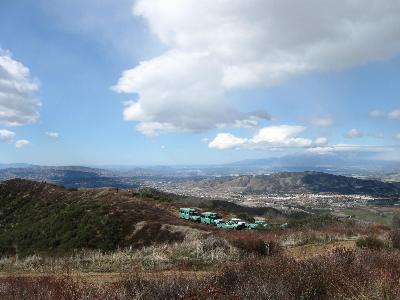
 A view across the mountains and valley where we worked on the fire break
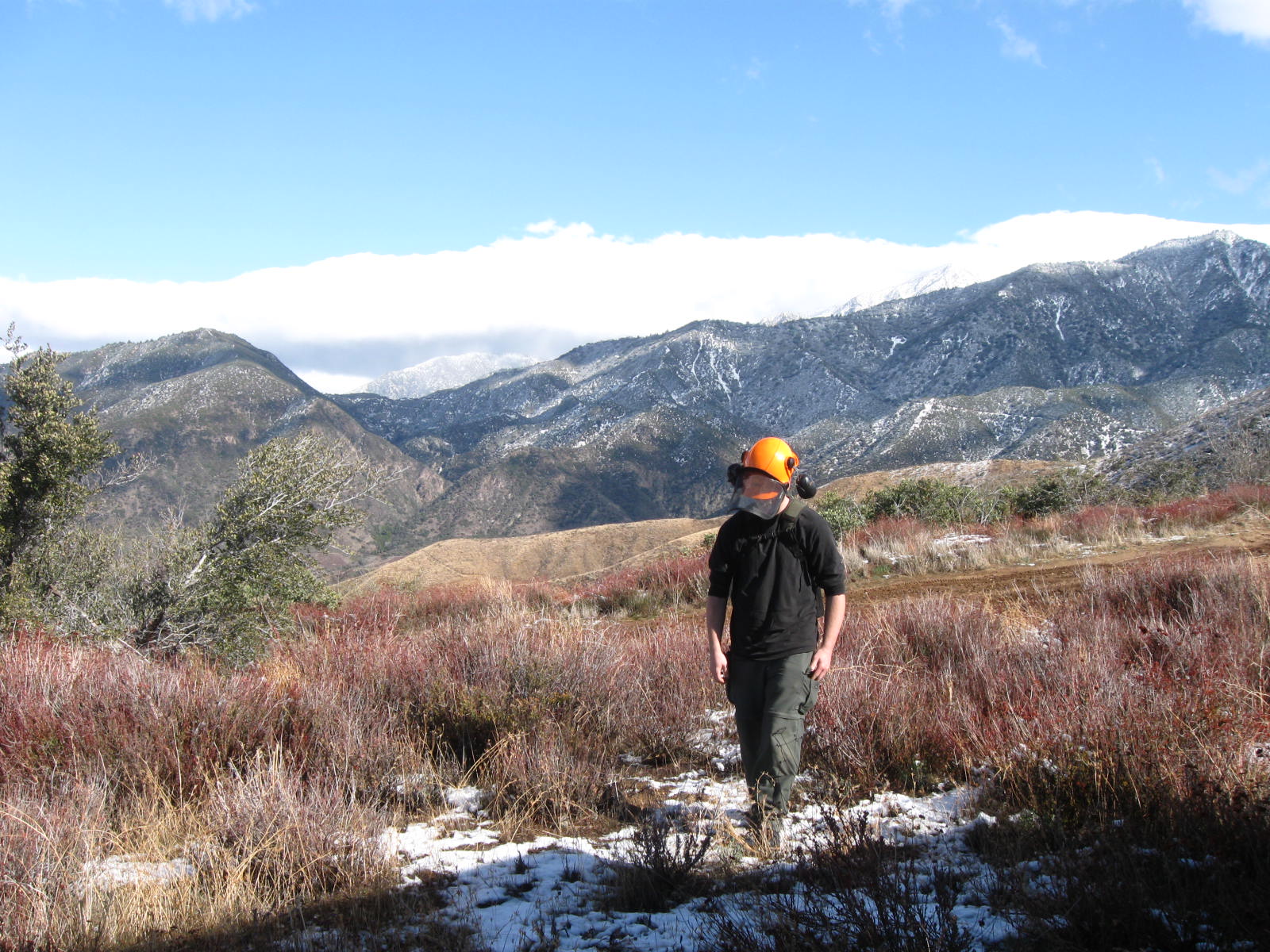 One of the Trailbuilder volunteers before suiting-up for the field training
 Another look at the snow at our elevation
 Another look at the awesome mountains around us
 Del Rosa Hot Shots
 The volunteers starting to gather for the final instruction before we break up
 Another look at the awesome mountains around us
 One of the Trailbuilders suits up for the hands-on training
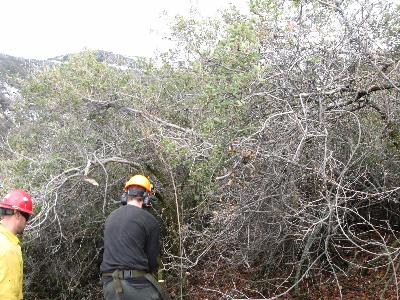
 One of the Trailbuilders cutting and swamping while the Hot Shot observes
 Another Trailbuilder cuts while being observed
 A look back at the transport vehicles which were left behind due to mud
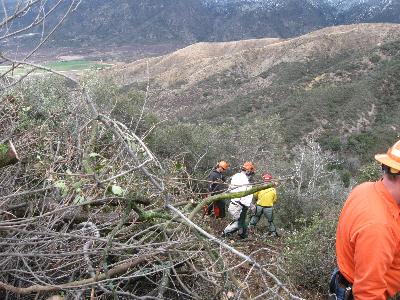
 Hot Shot swamps for the trainee student
 Hot Shot observes the trainee student, another look at the mountains
 Hot Shot observes the trainee student, another look at the mountains
 Note how closely the Hot Shot trainer watches the trainee during hands-on
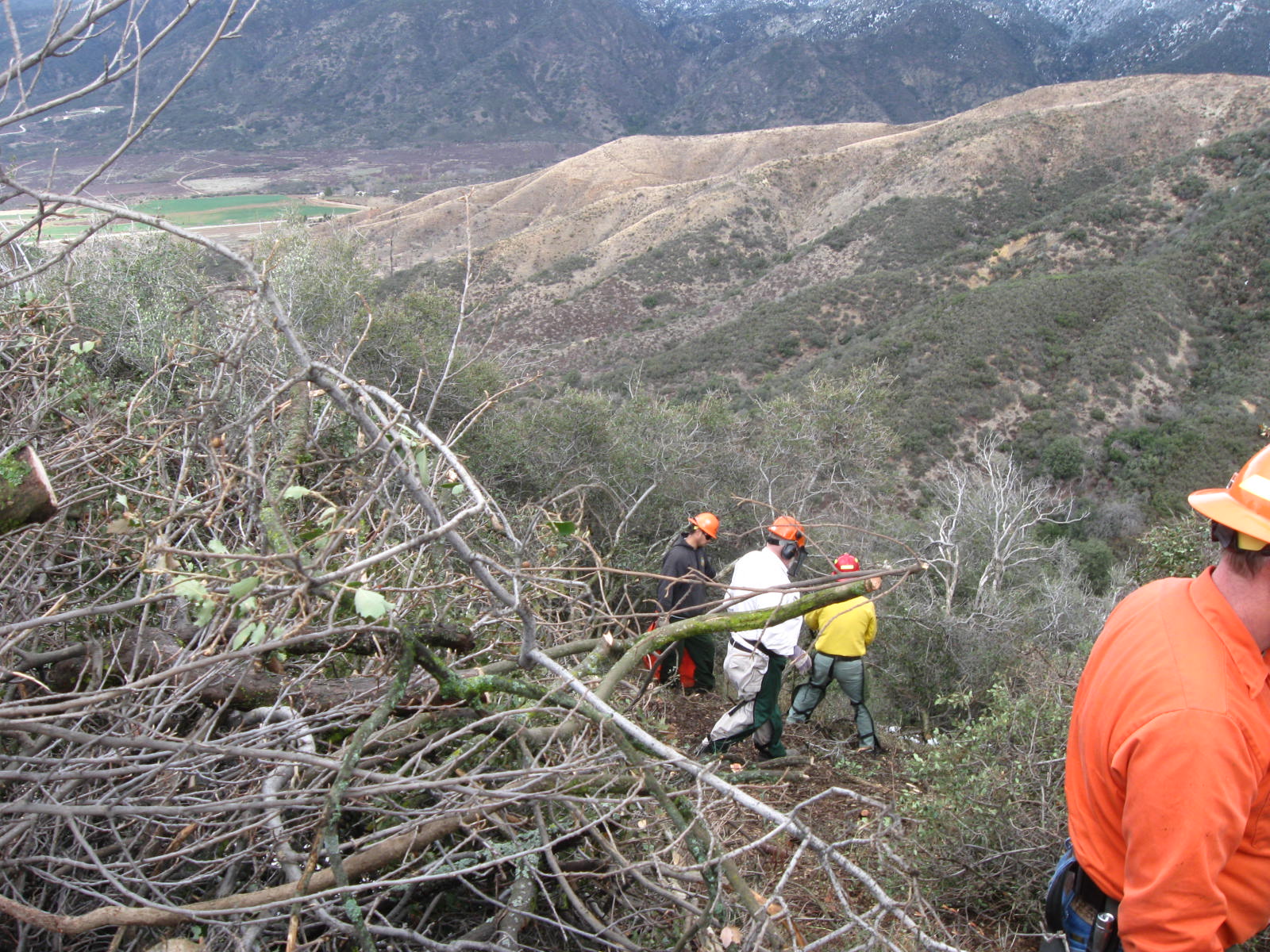 Another team, Hot Shot teacher also closely observing his students
 Another volunteer packs up his equipment
 After the second round of hands-on with a new Hot Shot instructor, some rest
 Hot Shgot instructor continues to swap and observe the trainee
 Toward the end of the hands-on field work before heading for more classroom
 Toward the end of the hands-on field work before heading for more classroom
 Toward the end of the hands-on field work before heading for more classroom
 Snow approaching! We should get off the mountain before too much mud comes
This web site is not operated or maintained by the US Forest Service, and
the USFS does not have any responsibility for the contents of any page
provided on the http://CrystalLake.Name/ web site. Also this web site is
not connected in any way with any of the volunteer organizations that are
mentioned in various web pages, including the
San Gabriel Mountains
Trailbuilders (SGMTBs) or the
Angeles Volunteers Association
(AVA.) This web site is privately owned and operated.
Please note that information on this web page may be inaccurate.