
Today was the best training session that that the
San Gabriel Mountains Trailbuilders
has organized since evah! Volunteers from forests and
organizations around
Southern
California were asked to send trail workers to attend formal
rigging and safety training
offered by the Trailbuilders, paid for in part by the
REI company
which promotes outdoor activities and coordinates forest volunteer activities
of their own.
This was a 2 day training event with about half of the 33 student volunteers
camping out in the forest, a fairly cold weekend in the
Angeles
National Forest but still comfortable enough for those of us who brought
a tent and two
sleeping bags like I
did! Of course I don't mind having freezing cold feet in the night since it
builds character and man! I got a lot of character built Saturday night
in the cold forest!
The Trailbuilders and literally all of the other volunteer groups which
attended the training have worked with rigging hardware before to various
degrees, all of us using ropes,
blocks, winches,
hoists and other equipment for trail work close to the ground. What
probably none of us has ever had has been formal classroom and
in-field training from experts on rigging so this weekend we had volunteers
with little experience with rigging mixed in with volunteers who have decades
of rigging experience getting a refresher on safety and getting good ideas
for efficient trail working methods.
The company that we bought in to give us our training is
Off The Beaten Path which also
has a
Facebook
page. Almost all of the equipment that was used in the field training
was provided by the Trailbuilders though other forest volunteer groups
brought some of their own hardware, including a massive
griphoist capable
of loading 8,000 pounds!
The first day of training consisted of a morning of classroom instruction on
the simple machines, stuff that most of us got when we were in grade school,
including how to figure simple math ratios that are used to ensure that the
loads one works with does not overwhelm the working and breaking limits of
the various components of the system being used to manipulate that load.
Coffee and doughnuts provided by the Trailbuilders helped to keep the students
alert and focused however from the first hour of the class everyone could see
that everyone was fascinated, alert, and highly focused on the training we
were getting, something that lasted through the whole two days. There was no
fooling around, nobody falling asleep, no chatter among ourselves, all 33
students remained tightly attuned to the instructor's efforts, occasionally
asking questions and describing briefly things they had done in the field,
getting feedback on how efficient or not such previous tasks had been
accomplished.
What we had were volunteers who are highly dedicated, very motivated people
who leaped at the opportunity to acquire skills and experience, training that
didn't require a fee to attend since volunteer groups and individuals often
find it difficult to acquire funding for needed tools and equipment, leave
alone formal instruction like this, we got a crowd that appreciate and
desire such classes as we had this weekend.
Of utmost concern during the in-class training was the safety aspects of
working with heavy boulders, tree trunks, and in some cases worked timber,
concrete, and steel, all of which unpaid volunteers might be expected to
utilize safely and with competence.
The Trailbuilders, people may recall, built the
John Seals
Bridge across Laurel Gulch along the East Fork of the
San
Gabriel River which consisted of getting lumber cut, milled, drilled,
treated, and delivered to the
Rincon
Fire Station where the bridge was assembled and worked to completion,
disassembled, and then transported by helicopter to Laurel Gulch.
What most people who saw that achievement didn't see was the rigging hardware
that was applied to that project, including the computation of load weights
and distribution that was performed to determine suitable helicopter
platforms, cable limits, and rigging hardware needed for the delivery, all
of which was worked out in advance with the assistance of professionals of
such solid competence and experience as we had during our training session
this weekend.
After the morning of classroom review we took to the field to take a look at
how levers, inclined planes, and pulleys work to apply
mechanical and
situational advantage with considerable time spent showing how such
advantage is a trade-off between Newtons of effort applied to perform work,
and the distance over which that work is applied.
The hiking trails that we establish in the
Western United
States, for instance, utilize long distances and reduced degrees of
inclination whereas in the rest of the United States trails that progress
through mountains are generally steep, trading shorter distances at the cost
of much steeper inclines.
The amount of work performed when hiking a trail is the same
regardless of distance-verses-incline ratios however the amount of
effort applied gets to be wildly different depending upon the
distance-to-incline ratio.
After getting a review of safety and the basic physics and math of utilizing
the simplest of tools, we got to participate and observe how blocks and ropes
worked in real life by tying off to a tree and applying a pulley, setting
people on both ends to establish a
tug of war scenario
which got more and more one-sided as additional pulleys were added to the
system.
For the first day of training the most amusing thing was the deliberate
attempt to break the
shear pins in one of
the Trailbuilder's griphoists. The machine is rated at 4,000 pounds of
working load
limit (WLL) and we had rigged the machine in line with a measuring
device using two trees as anchors so we could pump the hoist and see at
which point the shear pins would break.
Well, we tried a number of times to measure the points at which the pins
would break however we cranked until we achieved 6,400 pounds which was the
WLL for the weakest component in our system after which we stopped cranking.
Since the pins would not brake even well beyond their limits we removed the
hoist from the system and handed it to the Trailbuilders to extract the pins
and examine them, replacing them with spares.
What was amusing was that after pounding with a hammer and using a
bearing-puller on the handle, the thing would not come apart -- which was
not at all surprising once someone actually looked at the machine
and saw that someone had welded the thing. LOL! No wonder the pins would
not break! D'oh! So that means the organization will need to grind off the
weld, rework the pump handle, install fresh pins and re-test to ensure the
pins sheer properly.
That was pretty much it for the day. Since it was cold and getting dark
quickly there was a last round of examining our work areas for tools and
equipment scattered about, collecting them back to our main staging area
and leaving the current rigging in place for the morning's resumption.
Dinner was left over doughnuts, fresh coffee, and mixed nuts while laid
back in my sleeping bags reading
Moonseed
by Stephen Baxter wherein the Earth is once again destroyed utterly
through no fault of our own other than humanity's willful, comfortable ignorance.
LOL. I always like novels where everyone dies -- and I mean everybody
-- for some reason probably stemming from traumas suffered during my
precious, tender up-bringing, but when we're all irrevocably snuffed
though our own stupidity, griphoist by our own
petards,
as it were, I find myself checking the book out and reading it more than
once. :)
Morning, and the second day of training resumed with some more in-class
instruction, getting a look at not only more ground-based rigging efforts
but also
arboreal
rigging where large loads are transported above ground to minimize the impact
to the ground but also to provide options for transporting loads across
rivers, up and down steel slopes, and other environmental realities that
makes ground-based efforts either very difficult or impossible.
Most of the volunteers will not be performing this kind of rigging because
we lack enough healthy tree anchors in our forests to work with, but also
because it's rather rare to actually need to take an operation
through the air. If we work along a river or stream, there are suitable
boulders to work with on either side of the river that we need not sling
rigging across the river and work in the air.
At the same time the trail workers often do establish stepping stones across
rivers and streams that are seasonal, but we usually haul boulders along the
ground when water flow is either non-existent or minimum, working on the
ground. Air operations is very rare, if it's done at all, and is only
something that is done by volunteers who have literally decades of experience.
Safety is the issue here. If there's a job that needs to be done, volunteers
examine and evaluate it, and if it's beyond their training,
volunteers simply don't do it.
After the classroom we again took to the field, this time working with a
large boulder in the grounds of the
Rincon
Environmental Education Center where we were getting our training. In
addition to dragging the boulder around and applying situational advantage
to re-vector forces away from the volunteers working with the rigging, we
also saw how we could utilize rigging to flip boulders over and across the
ground, minimizing erosion and damage to the ground.
After lunch we took to the nature trail next to the Education Center that
the Trailbuilders had established many year ago, taking a look at two
hazard
snags that
needed to be brought to ground safely before children could come and hike
the trail during the Summer.
Normally we would
buck the trees as
they leaned, doing so carefully and slowly, examining and evaluating the lay
of the hazard and reducing it little by little until the hazard is
eliminated. Many times, however, it is easier and safer to pull the hazard
to ground and then buck it up with
chainsaws and then
remove it from the trail.
We took considerable time working with pulling the largest hazard down to
ground first since I was worried that it might take us in to the evening
when it gets dark, and tacking the worse hazard first seemed like a good
idea in the event we ran out of daylight and could not get to the second
hazard.
Here was some very good instruction. Working with another 4,000 WLL griphoist
that the Trailbuilders had we managed to shear the pins, allowing people to
see how the pins are extracted and replaced in the field while also seeing
what happens when the pins give way, something we amusingly could not
demonstrate on the first day of class.
At the same time we had to evaluate the working load to see how we might
improve the mechanical advantage using a block or two, reconfigure the
rigging so that the effort at the hoist would remain less than 4,000 pounds
while also increasing the loads at the dead tree end while still not
exceeding those components' working load limits.
It was enough to add a
power block to the
system which cut the load on the hoist by approximately half while doubling
the pull on the tree while also doubling the lay length of the
wire rope going
through the hoist.
It took time to get the first hazard to ground since in addition to
installing a moving power block, once the power block met the stationary
block and the tree was still not grounded two volunteers worked forward
while avoiding the unsettled tree, reworked the rigging safely to tighten
the sling, then the hauling was resumed, finally bringing the tree to ground.
The second hazard was also a good way to examine the safest way to eliminate
the leaning tree which had been broken about 5 feet above ground, shattered
but still with a lot of holding fiber. Because the tree was shattered and
splintered, it was obvious by examining it carefully that it should be easy
enough to loop a choker sling on the top fragment pull the fibers apart,
slowly dropping the hazard to ground.
Normally volunteers like me would simply apply the sling, anchor the
griphoist to a healthy tree, and haul away from a safe distance however it
was pointed out again -- as had been pointed out many time during the
training days -- that pulling the tree to ground that was meant that the
person pumping the hoist would have
force heading straight
for her which, in an equipment failure situation, could mean a less safe
operation than a second option which we instead employed.
We used a second tree midway between the working load (the tree we were
breaking and pulling to ground) and the anchor tree (upon which the hoist
was attached though another sling) and attached a snatch block. As the
volunteer cranked the hoist, force was vectored toward the midway tree
rather than directly at the person working the hoist, improving overall
safety at the expense of adding a minimal amount of
friction
to the system.
By this time it was getting cold again and it was time to start ending the
class. There was the need to scour the grounds inside and outside of the
fence to ensure that every piece of equipment was collected, every scrap
of litter was picked up, scratches carved in the ground were patted back
in to place, the classroom facilities and the toilets swept out and
everything cleaned up, a final effort that took about 2 hours since there
was a lot of equipment to account for.
Let's do this again, if possible. We need to get together a second class
that is more advanced which covers the use of more tools that might reduce
effort and increase productivity in the field while again underscoring
safety, an advance class that perhaps has fewer students but consists of
3 or 4 days of highly detailed training, doing actual field work on
projects that are needed to be done in the Angeles National Forest.
We might organize a second, advanced training effort though for that we'll
need to ask students to assist with the cost of holding such training. But
that's for the future, if ever, but for now 33 students have gotten
ourselves some highly valuable training for which the
REI company,
the
San Gabriel Mountains
Trailbuilders, and the
U. S.
Forest Service deserve a much heart-felt "thank you."
The people who attended learned a lot and can bring their training back
to the groups they participate within, imparting some of what they learned,
all to the benefit of the forest and to hikers, bikers, climbers,
backpackers, and everyone who recreates in the forest.
Photographs of the training are offered below but also check out the
Concerned
Off-Road Bicyclest Association photographs.
Mitch
photographs.
Note: The Pacific Crest Trail Association
was also represented in the training this weekend.
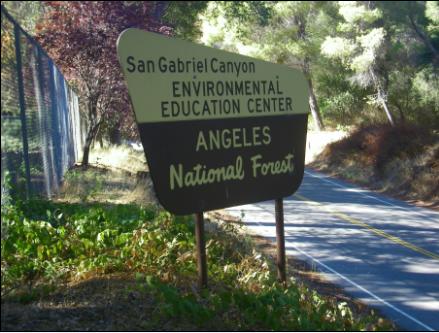
 Environmental Education Center
 Staging up the rigging equipment
 Two of the griphosts that the Trailbuilders use
 Close up of the wire cable and blocks that will be used during training
 Shackles, slings, chain, other rigging equipment
 Many different types of shackles, some round, some flat, working rope
 Some webbing and a port-a-belay device, among other equipment
 Fiber rope and a rock bar
 The students gather around the instructor in the field to review equipment
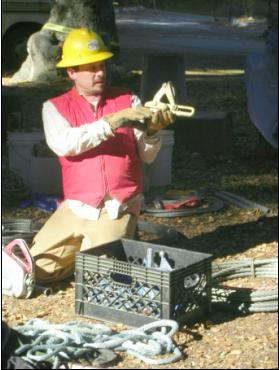
 A wire cable gripping device is described and demonstrated
 The larger griphoist that the Pacific Crest Trail Association has
 The instructor demonstrates how wire rope is threaded through the hoist
 Details of how the hoist mechanism engages forward and backward
 A blue composite rope commonly used in rigging is described
 A force measuring device is described and demonstrated
 A wifer view of some of the rigging equipment
 Instructor and student demonstrate ways to apply a sling
 Another cable-gripping device in among PCTA hardware
 Rock sling shown being used on a wood stump
 Common chaining of a rock demonstrated on a wood stump
 Chain-clasping hardware shown being used to tighten chain on a wood stump
 Chain being applied to a trash container to demonstrate other shackles
 Another photograph of rigging equipment in the stage-up area
 The instructor describes how the PCTA's wire-rope-gripping device works
 The force-measuring device close up
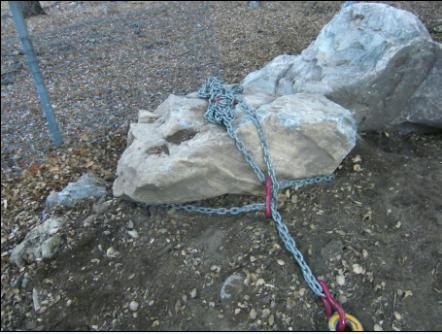
 Students apply chain to a sample boulder to be moved
 Griphoist, sling, and anchor
 Midpoint block used to revector force
 Sling, hook, cable eye
 Sling used to attach midway block to revector force
 An improvised friction belay and shackle
 Griphoist, force measuring device, and sling
 Far anchor using a sling
 A closer look at the force measuring device and griphoist
 Moving the boulder along the ground
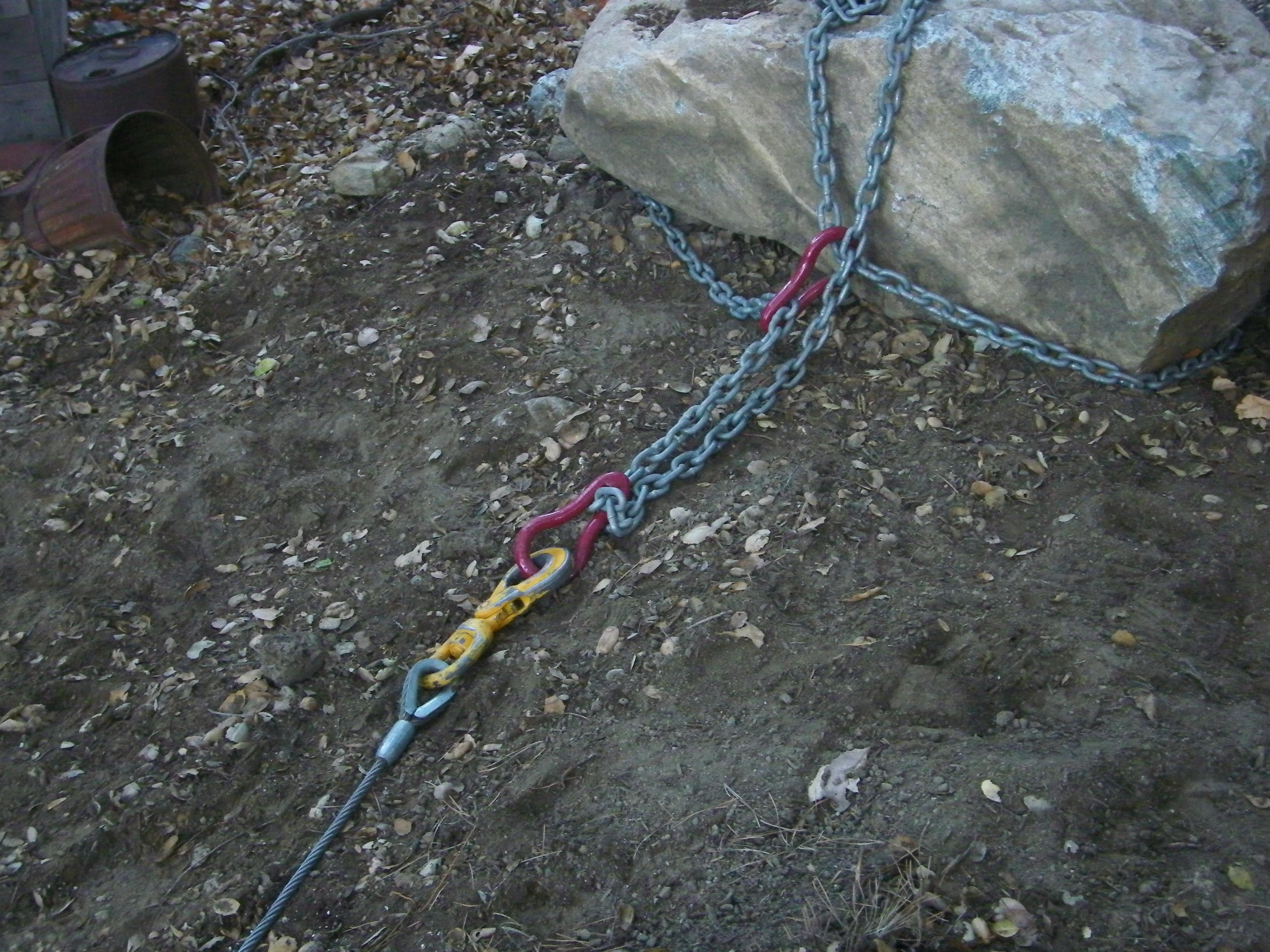 A good look at the use of shackles and chain on the boulder
 Back to trying to shear the safety pins on the griphoist
 Floating block while the boulder is being moved
 Floating block while the boulder is being moved
 Examining the griphoist whose shear pins refuse to break
 Student cranks away at the hoist
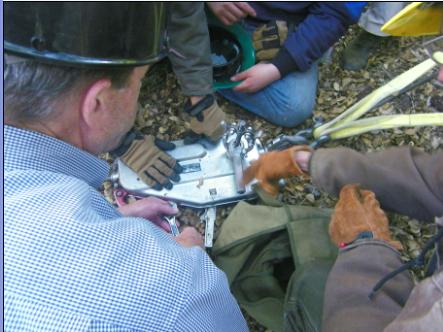
 Attempting to remove the handle and swap the pins on the welded hoist -- LOL!
 Flipping the boulder end-over-end
 Rigging in place while more instruction takes place at the second hoist
 Digging under the boulder to apply chain in a new configuration
 Now a strap is used on the boulder along with a block
 Shackle applied to chain on boulder
 Shackle applied to chain on boulder
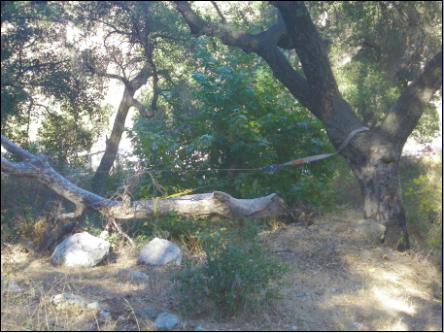
 A look at the first hazard in the nature trail
 A very heavy anchor tree for midpoint revectoring of force is selected
 A choker configured strap on the working load
 Midpoint block and strap for the first hazard
 Tension applied to the first hazard reduction effort
 After the shear pins break we get a look at replacing them in the field
 The handle is successfully removed from the griphoist
 Trailbuilder Josh holds the shattered pin fragments
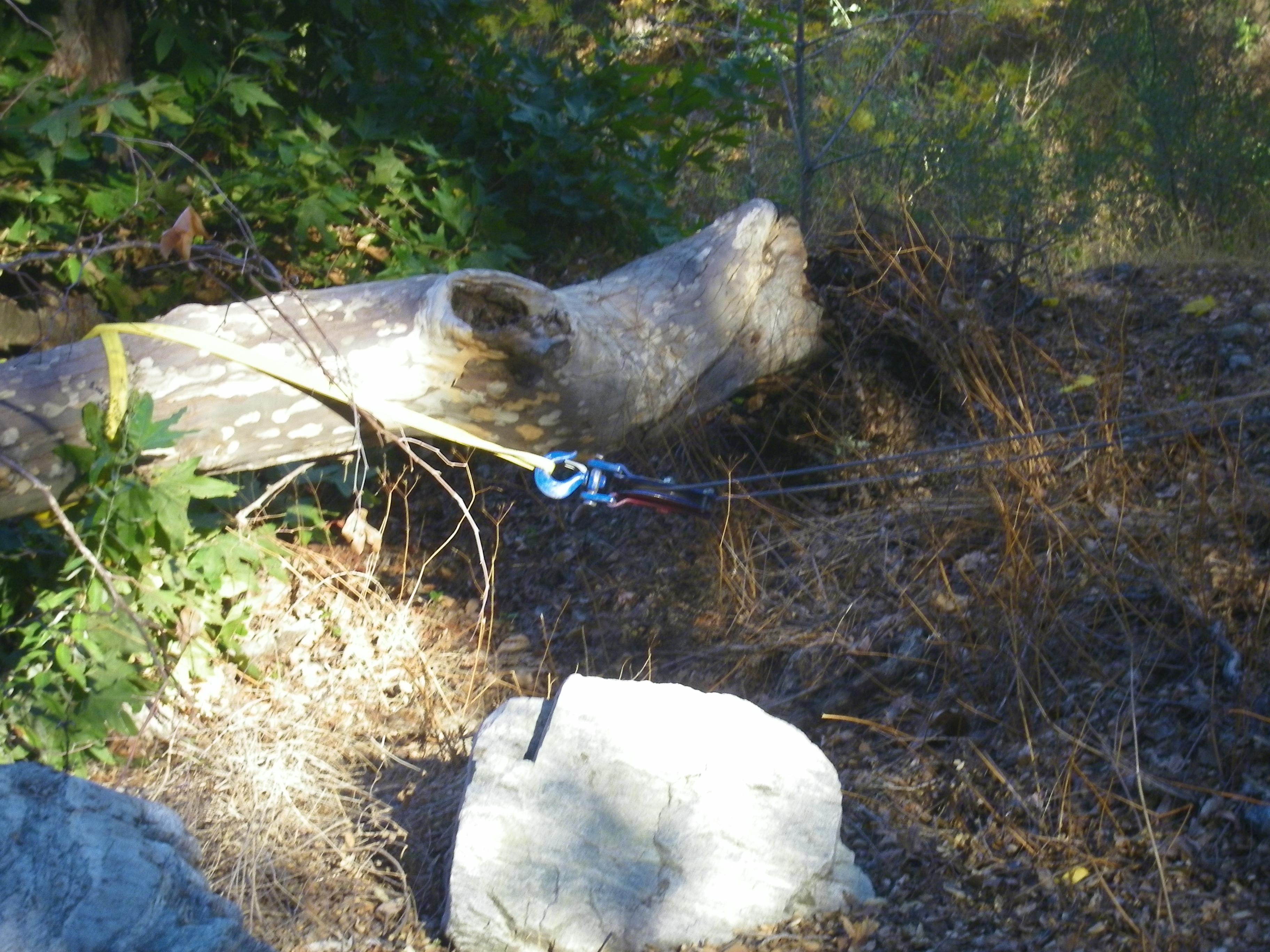 A closer look at the working load with a new power block added
 The hoist reassembled now that the rigging has been reworked
 The hazard starts to come down to ground
 Classroom instruction
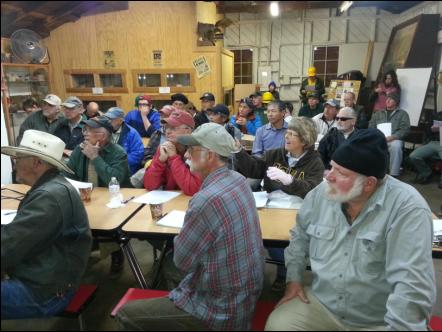
 The classroom is full, we had 33 students, everyone highly focused
 Students gather around the equipment staging area
 Students gather around the equipment staging area
 Students gather around the equipment staging area
 Students gather around the equipment staging area
 Instructor covers what we will be covering in the field for the day
 Tug-of-war with a single block, then 2 blocks, then 4 blocks
 Tug-of-war with a single block, then 2 blocks, then 4 blocks
 Tug-of-war with a single block, then 2 blocks, then 4 blocks
 Threading wire rope through a griphoist again
 SHowing the two anchors being used to try to shear the pins on a hoist
 A look at the boulder moving effort after it has been moved
 The second hazard before it is addressed and pulled to ground
 On-going effort to bring the first hazard fully to ground
 On-going effort to bring the first hazard fully to ground
 Cable minders ensure the working main cable is carefully tended
 Another look at the first hazard and where it's located
 On-going effort to bring the first hazard fully to ground
 The first hazard fully down on the ground
This web site is not operated or maintained by the US Forest Service, and
the USFS does not have any responsibility for the contents of any page
provided on the http://CrystalLake.Name/ web site. Also this web site is
not connected in any way with any of the volunteer organizations that are
mentioned in various web pages, including the
San Gabriel Mountains
Trailbuilders (SGMTBs) or the
Angeles Volunteers Association
(AVA.) This web site is privately owned and operated.
Please note that information on this web page may be inaccurate.