
Hot! It was a very hot day working in the Angeles National Forest, but it
was also something of an unusual day for the
San Gabriel Mountains
Trailbuilders since today a team of six set out early to try to get a
jump on things before things got to be too hot, and to try to get up to
Islip Mountain in
an effort to complete the removal of the last remaining dead tree from along
Islip Ridge Trail,
all the way from
Little Jimmy Trail
Camp to the
Big Cienega
Trail junction.
And what fun it was, too! Despite the heat, dust, ash, threat of lightening
strikes, all that happy nonsense.
As you may have seen in previous write-ups covering the trail efforts in
and around the Crystal Lake basin, the last survey of this trail had seen
that there were four remaining obstructions to remove, so the Traiulbuilders
were dispatched to take care of those, after which the forward team would
work their way down the Wawona Cutoff toward the lake parking area, meeting
up with the rest of the Trailbuilders working their way up the trail removing
brush and fixing erosion, among other trail repairs.
Because of the
Project Activity Level for
the
Angeles
National Forest area where we would be working, all
chainsaw activity needed
to be suspended at 13:00 and, given the heat of the day, it is always a good
idea to try to get out in to the field early in the Summer months compared
to cooler seasons, so today the Trailbuilders split in to two teams.
The volunteers met at the Rincon Fire Station where we examined our tools and
equipment, making sure we had all of the fuel and oil we would need for the
chainsaws, checking the condition of our Kevlar safety chaps, hard hats,
checking our chains to see which were sharp and which were trash, and then
finally we climbed aboard the big red pickup and headed further North along
Highway 39,
all the way to
Angeles Crest
Highway and from there to Little Jimmy Trail Camp.
Along the way we passed a large number of people on bicycles working their
way up from Azusa all the way to Angeles Crest, a trip of about 30 miles and
maybe some 7000 feet or more of altitude gain, but in the canyons the bike
riders could be assured of shade from time to time, and along the way there
are a number of small streams to cool off in.
When we got to Little Jimmy we were somewhat surprised to see it empty, not
a single camper was there. A number of people were hiking the
Pacific Crest
Trail in that section but the entire campgrounds were empty of campers.
Interesting. It takes a bit of hiking to get in to the Trail Camp, and
maybe the heat of the previous day kept people away. Well, we had the place
to ourselves anyway.
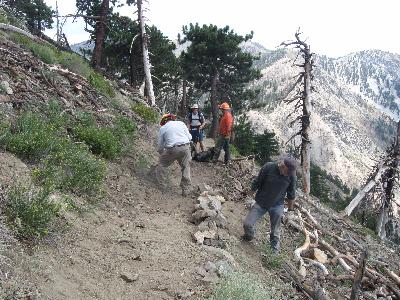
We shouldered our chainsaws, hung tools from our backs and belts, picked
up long tools and axes, and then finally we set our feet upon the trail,
heading toward the first obstruction.
What we found was a major difficult snarl of tree roots at the end of a large
obstruction on Mount Islip that was not in our inventory of work for the
day, and checking the rest of the trail all the way to the peak we found
two additional obstructions that were not on our list.
Ha! It is always this way, because of the
Bark Beetle infestation (please check that link if you have not looked at
the phenomena lately) and the
Curve Fire,
dead pines and the occasional dead oak trees continue to fall down upon the
trails, or they continue to shed branches which obstruct the trails, and while
hikers, bikers, backpackers, climbers and such climb over, under, and around
them, the temporary usage trails that get forms add erosion and might not be
quite as safe as specifically designed trail sections, so the Trailbuilders
remove the obstructions, eliminate the temporary bypasses, and re-establish
the original trail, doing so as close to the original trail as possible
within inches since the
U. S.
Forest Service expects it, and it's the professional thing to do!
The first major obstruction had never been reported, perhaps because it had
been blocking the trail for about 2 years and the temporary usage trail that
bypassed it was so well defined by hikers that nobody bothered. Still, bucking
up that major problem was a long, slow, careful effort that took about 2 hours.
You might think that taking over 2 hours to buck up and remove a dead tree
that's about 3 feet wide is a rathyer long period of time for just one
obstruction, yet if you look at the photographs you'll see why the Trailbuilders
go the extra mile, take the extra time to take everything slowly, carefully,
with much planning and discussion and in-field training of new volunteers
to ensure that there are no crushed fingers, thrown tree fragments, all of
the potential difficulties that might cause injury. So 2 hours plus was
something of an impact on our hoped-for schedule for the day, but Safety
First is paramount.
While that obstruction was being worked on, a second chainsaw went up Islip
Mountain all the way to the peak and quickly took care of the other two
obstructions, leaving most of the volunteers with little to do but wait for
the large tree to be completely bucked up and get removed so that the trail
could be restored back to its original condition.
When finally Mount Islip was finished and the trail looked wonderful again,
the forward team headed down Islip Ridge Trail and bucked up and removed
all of the remaining obstructions and found themselves with about
seven minutes of available time before the 13:00 cut-off time was reached.
There was still a lot of work to do on the way down the mountain, though.
Boulders to be removed, leaning trees to be examined, tree bark to be
collected and shoved over the side, by the time we got to the meeting point
on
South Mount
Hawkins road to meet up with the big red pickup again, it was rather
late and the other Trailbuilders who had sweated and worked their way up
some 2 miles of Wawona Trail were already on their way back down the mountain
and, hopefully, cold ice tea -- or at least something to cool off with.
The six of us still working our way down Islip Ridge Trail eventually
stopped by Adam's cafe at the Visitor Center, checking out the general
condition of the camp sites in the area which were moderately full but
still had a few sites open, with lots of people playing games, lots of
bicycle riders still coming up and going down, kids running around, everyone
enjoying the cooling evening as the rather brutal Sun started westing behind
the mountains.
It would have been nice to lay back right there on the asphalt of the Visitor
Center parking lot somewhere in the shade and sleep for a few hours before
heading back down the mountain but alas we finally all climbed aboard the
big red pickup and returned to the Rincon Fire Station after which we were
done for the day! And what an unusual day it was.
With some 2 miles of Wawona getting opened up, bushed back, erosion repaired,
and with Islip Mountain and Islip Ridge Trail fully opened, a great deal of
work was accomplished, and basically the only thing left is to complete
Wawona thereafter the Trailbuilders will perhaps do another survey of all
the trails to see what the new schedule should be.
Perhaps the next big thing is the repair of the Sutter Walls along Windy Gap
Trail, or perhaps Sunset Ridge Trail which is just above Deer Flats Group
Campground since there are a number of trees down along that short nature
trail. Perhaps Islip Trail or Windy Gap will be widened some more to afford
access to pack animals which will help in the trail maintaining effort.
Regardless it will be fun!
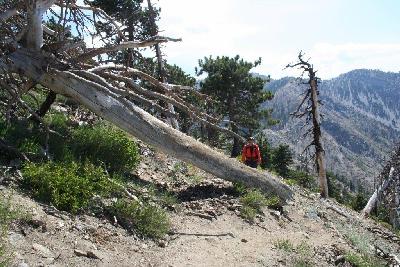
 The first major obstruction on Mount Islip
 The root ball gets bucked up
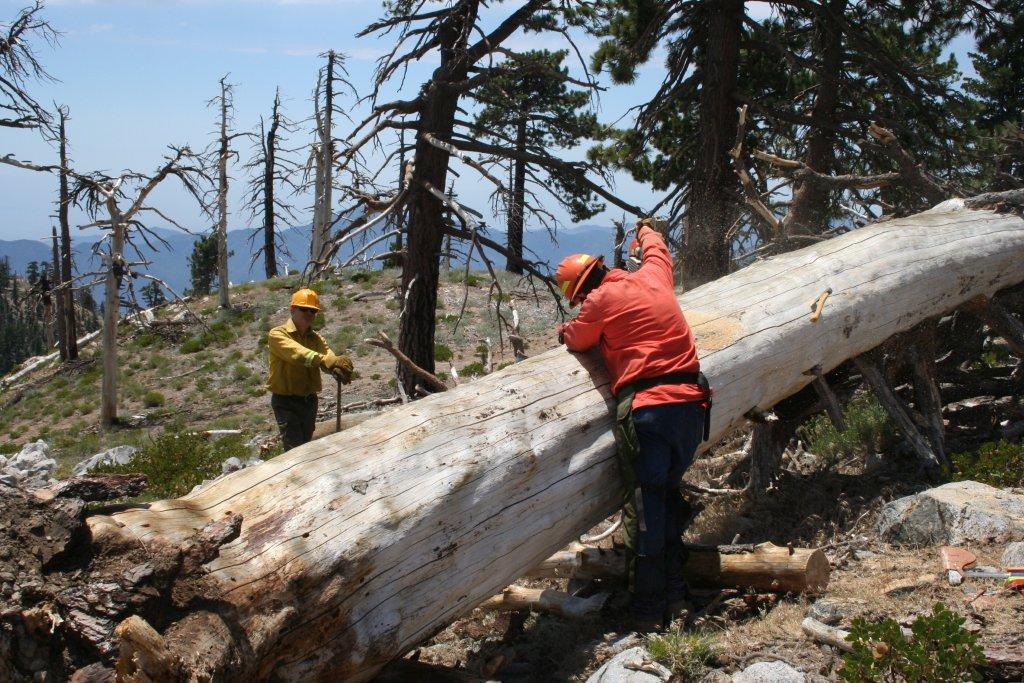 Second obstruction Fred watches while Jonathan uses the saw
 Chainsaw half way through on far side
 Bryan works on bucking up the third major obstruction
 Fred tries to remove some of the healthy bush right in the trail
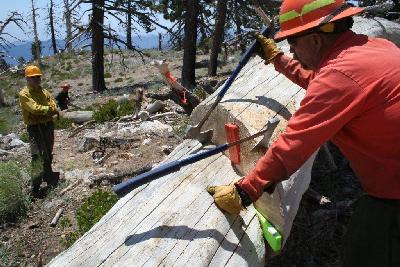
 Meanwhile three wedges, two holding wedges on the second obstruction
 After the holding wedges are removed, everything drops slowly and controlled
 Fred takes a break from trying to kill the local flora
 At the fifth major obstruction we discuss where the trail traditionally goes
 The first major obstruction and its large root ball
 The second obstruction before work gets started on it
 Hikin' Jim's daughter pauses to rest on Windy Gap Trail
 Hikin' Jim's daughter fills her drink container at Little Jimmy Spring
 The trailhead at Little Jimmy Trail Camp
 We get our equipment together at Little Jimmy
 We pause to rest a bit before starting the next effort
 The view from Mount Islip
 The first major obstruction and what it looks like from the trail
 A wider look at the first obstruction and the temporary use trail around it
 Bryan watches at the roots are removed
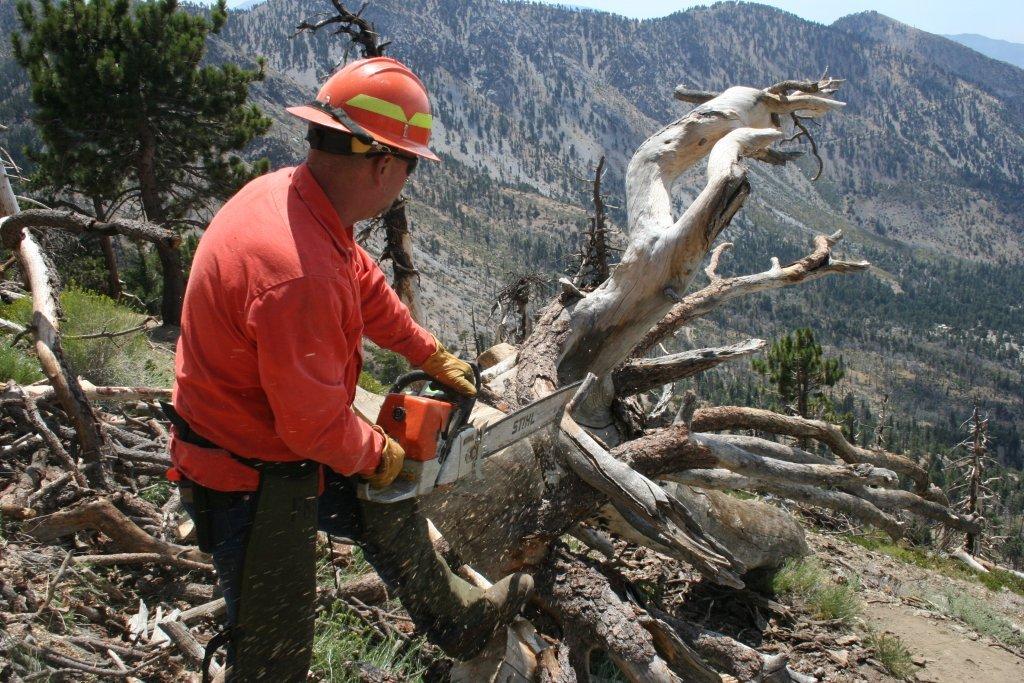
 A look down on the chainsaw effort from the obstruction further up the trail
 Another obstruction on Mount Islip
 Bryan removes that obstruction further up Mount Islip
 Obstruction removed but the trail still needs cleaning
 Meanwhile the first obstruction has been cut back quite a bit
 First obstruction removed, now the trail starts to get repaired
 Mostly finished, a retaining wall is established with rocks
 The trail section is finished!
 The sign where Windy Gap, Islip meet at this point
 We use almost entirely Stihl chainsaws -- for obvious reasons :)
 Back at the second major obstruction -- which is actually two trees
 This is the second obstruction right after the second one
 The trail in between gets worked, brush removed to re-establish the trail
 Tree limbs are placed under the trunk to make it slide easily
 South Mount Hawkins from where we are working
 The next obstruction is much smaller and takes 2 easy cuts
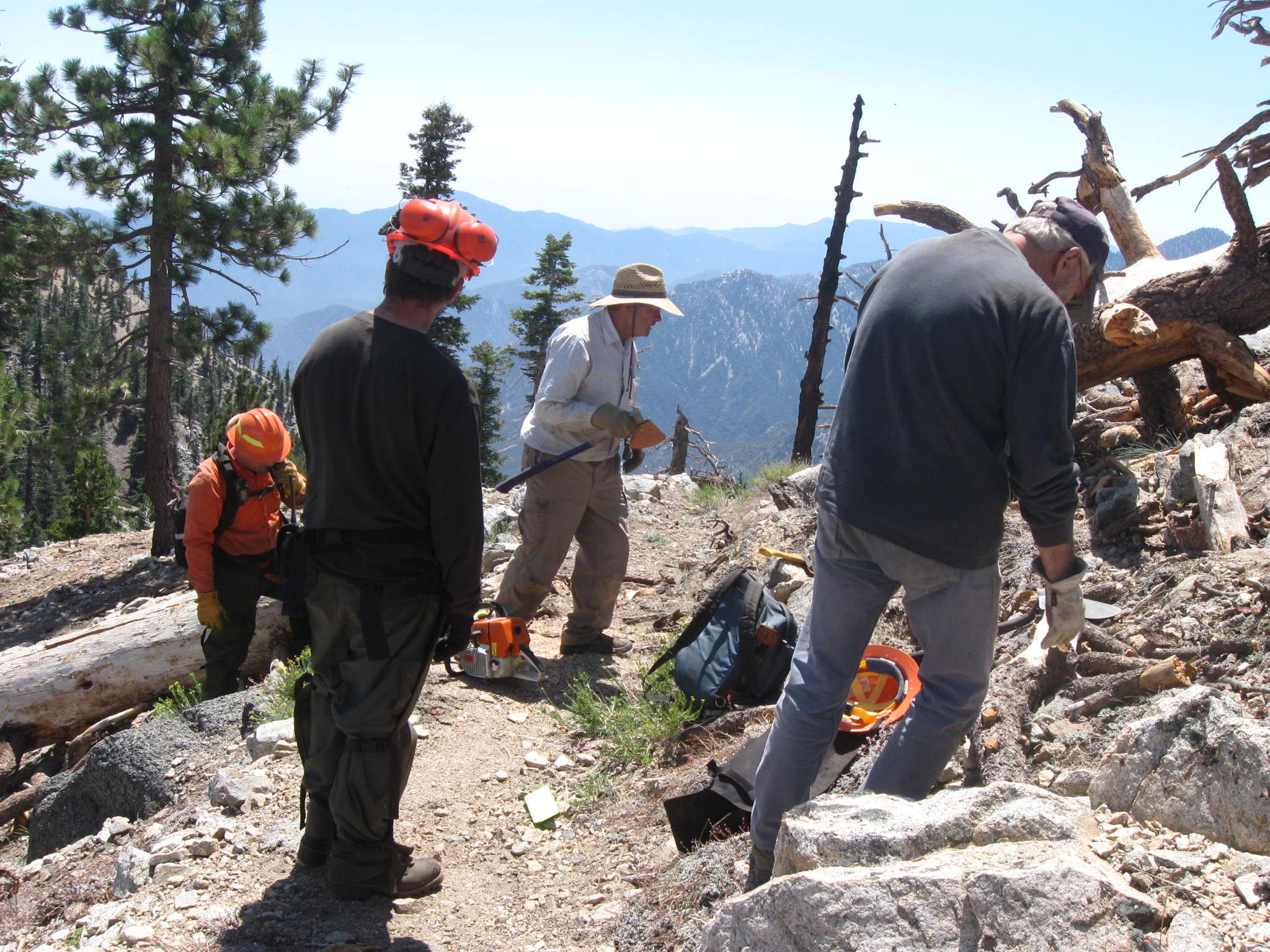 Obstruction removed, the trail needs to be cleaned up
 The last major obstruction has obscured the trail entirely
 That major obstruction has been removed, the trail now gets worked on
 Bob removed some of the brush to re-establish where the trail goes
 Holding wedges get removed so that the bucked section drops slowly
This web site is not operated or maintained by the US Forest Service, and
the USFS does not have any responsibility for the contents of any page
provided on the http://CrystalLake.Name/ web site. Also this web site is
not connected in any way with any of the volunteer organizations that are
mentioned in various web pages, including the
San Gabriel Mountains
Trailbuilders (SGMTBs) or the
Angeles Volunteers Association
(AVA.) This web site is privately owned and operated.
Please note that information on this web page may be inaccurate.