
On 14/Sep/2009, the National Parks Service came to Glendora Public Library
for a two hour review of proposals outlining changes in the way the Angeles
National Forest / San Gabriel Mountains / San Gabriel Watershed could be
managed, funded, or improved primarily in terms of resource protection and
recreation.
I took notes and a few photographs and I've written them up here so that
people who were unable to attend will at least have my impressions. You
may find this somewhat long however a great many issues were briefly touched
upon and the room was filled to overflow with people who had many questions,
crammed in to a 2-hour meeting. I may be badly mistaken in what I report,
so please let me know if I got something wrong and I'll fix this write-up.
The NPS was tasked by Congress in 2002 to review the San Gabriel Mountains
and Watershed to review and draw proposed plans with a number of alternatives
with a number of stated goals, among them being increasing recreation
opportunity and determining means of maintaining or improving resources
in the face of more people utilizing increased recreation opportunities.
Starting around 2005, four preliminary plans were developed which provide
a very gross overview (at least the versions offered to the public) of
proposed changes in the San Gabriel River Ranger District of the United
States Forest Service and the wider San Gabriel Mountains within which
the District operates, including the watershed that extends South past
the mountains and in to population centers in the cities and townships
below.
I won't describe them in detail since they're on the NPS web site, but
I'll summarize very briefly what the proposals are as they relate to the
Angeles National Forest.
My impression (right or wrong) was that the Congresswoman Hilda L. Solis
(
http://en.wikipedia..org/wiki/Hilda_Solis)
requested the study for reasons having to do more with drinking water than
anything else however water was not a stated primary issue at the meeting
although it did come up (I brought it up as did a number of people in our
subdivided group.)
(A) This proposal would basically be a "channel of Federal
funding" to the United States Forest Service which would allow the
USFS to improve services to address understaffed but vital tasks such as
garbage and litter collection, spray paint removal, safety issues (law
enforcement i.e. drunk driving, domestic assaults, all that,) fire
mitigation and incidentals (medical assistance, educational talks, hikes,
school activities, all the things the USFS does every day) perhaps by
funding seasonal employees and slowing down or halting the periodic
budgetary cutbacks and staff reductions the USFS Nationally is plagued with.
Plan (A) would also provide NPS staff for administrative duties and for
technical planning and design of revitalization programs within the San
Gabriel Mountains however the NPS would be basically in an advisory role
for planning and such, the USFS would, if I understand things correctly,
carry on as normal yet with better funding which could be used to address
pollution, crime, water quality, and problems in the region.
(B) This is basically a "let's ask every region, agency, group, private
individual, private company, and everybody else in the region to agree to
cooperate on a voluntary basis and attempt to acquire funding for
improvement through grants and donations."
I simplify Plan (B) considerably but boiled down to its basics, I think
it devolves to asking "pretty please" for funding from unnamed,
vague "someone" and is predicated more on hoping the future will
take care of itself rather than an actual proposed plan. Maybe I'm wrong
but it sounded more like what's known in football as a "Hail Mary
Pass" – close one's eyes, throw the ball, and pray for the best.
(C) This proposed alternative describes how the NPS would become a
cooperative agency with the USFS and other agencies (which I assume
include the water authorities) which would leave the individual agencies
and organizations in control as they always have been however like (A)
would have the NPS perform technical assistance, planning, and administrative
service.
(D) This plan is "do nothing." Leave things as they are. There
was no paperwork provided on what doing nothing would mean insofar as
changes in the ANF despite the fact that doing nothing would result in
all the continued changes that are already constantly on going. Water
quality is maybe not getting any better, drunk driving kills people on
our canyon highways, virtually unchecked car and motorcycle racing kills
innocent bystanders every year, vehicle break-ins and all that would
continue witout being addressed more than they have been under this plan.
The meeting began at 7:05 P.M. I managed to bicycle to the library an hour
early so that I could take care of some paperwork and be sure of getting a
good seat. A preliminary count of the number of chairs provided in the
upper floor meeting hall was 120 and as 7:00 approached, every chair in
the room filled up and people were left standing in the back of the room.
I avoided the cookies but there was a huge pile of them.
First thing, I looked at who had come. Overwhelmingly it was older people
though perhaps 20% in their middle ages like myself. Also the crowd was
physically fit, I noticed. I checked the sign-up sheets and saw a wide
variety of groups represented including many people who just wrote down
"myself" or "citizen" or "hiker" in the spot
where group affiliation was asked for. "Hippie" was listed in
there, and some people just left the affiliation spot blank.
The Forest Service was represented by the San Gabriel River Ranger
District's Ranger showing up and participating as one of the people in the
large crowd, I was very happy to see, accompanied by two or perhaps three
other USFS personnel including, I believe, Ms. Jody USFS from Arcadia.
The Fisheries organization which does fantastic volunteer work in the ANF
was there, as was the Sierra Club, hiking groups, biking groups, horse
groups, science education groups, and other short-term environmental groups.
There was wide interest represented at the meeting to judge from the sign-up
sheets and the identifications people gave for themselves.
A brief slide show presenting the first 3 alternatives was offered lasting
about 20 minutes. Because there's a lot of material that we went through,
and because the information itself was in the hand-outs, the slides were
stepped through in some detail but rather quickly. I got the impression
that most people – and the people around me certainly – were already familiar
with the information in the slides and hand-outs.
The lights came up and there was 45 minutes of questions and answers.
Perhaps 30 questions were handled in that time frame however there were
probably 150 questions people had though the focus of the meeting wasn't
to get in to the nitty gritty details of what would happen if one plan or
another were presented to Congress, it was more tailored toward answering
wider issues of the proposed plans.
While still in a group of around 130 people or so, one question that was
asked was for the NPA to offer some examples of where cooperative Plan (C)
type consolidation had been performed and to describe what the consequences
had been after consolidation. The NPS representative described a fairly
large number of parks where multi-agency collaboration had been instigated,
she offered six or seven locations.
While listing locations where cooperative adventures had been instigated,
she did not describe what the various successes or failures of each location
had been however it sounded to me like she selected parks where people
already know about what they're like or could go on line and see official
web sites or discussion forums about the parks.
Another participant asked the large group why the NPS does not believe it
feasible to designate the Angeles National Forest and San Gabriel Mountains
to be a National Park. Instead it would be classed as a National Recreation
Area (NRA, the name of which came up for discussion later.)
The issue is that the watershed which exists at the alluvial planes at the
base of the mountain and extend South in to the San Gabriel Valley on their
way to the Pacific Ocean pass through populated areas where there are
residential neighborhoods, malls, shops and such. The "watershed"
aspects of the San Gabriel Mountains do not actually end where the mountains
end, the underground aqua-fir, injection wells, draw wells et al. extend
from the whole of the ANF reaching South toward the ocean.
In this respects, the San Gabriel Mountains / San Gabriel Watershed are
unlike the traditional parks that the NPS have oversight for. Additionally
the USFS already has the dedicated and experienced staff and, more
importantly, the knowledge of the local flora, fauna, environment, social
cultures, problems, solutions, and the day-to-day behavior of the ANF. The
NPS can't have the ANF designated a NPS Park and then just take over, it
would be a disaster and would undermine the goals: increase recreation,
maintain or improve resource protection in the face of increase recreation,
focus on conservation.
The most interesting question that drew chuckles and then anticipatory
silence was also when we were in the large group when someone asked what
the NPS's suggested best plan of all four were. It's an interesting
question because the NPS's job in this is not to make recommendations
or suggestions, their job is to evaluate alternative plans to meet
Congressional requests, soliciting input from the public, involved
agencies, and everyone else who has suggestions or comments and questions,
then to present the best alternative back to Congress where it may or may
not be acted upon.
The NPS didn't really feel comfortable answering the question flat-out, I
got the impression (and I believe most of us got the impression, hence the
chuckles) however she stated that (A) boiled down is a USFS funding channel
whereas (C) boiled down is a combined NPS and USFS funding channel. (B)
was unsavory and there was very little interest in that alternative at the
meeting. It got some minor talking-up but was avoided.
I wish that the USFS could have answered this question, perhaps the Ranger
being asked what she and her colleagues thought about the four plans and
which she would prefer. The meeting was to address the proposed plans,
however, not to ask agency opinions about things, but it would have been
informative to hear the Ranger's opinion on the proposals.
The USFS get to see everything that goes on and get to experience every
activity and situation that takes place in the ANF whereas volunteer groups,
law enforcement officers, and individuals only see parts of the whole. By
far the USFS's opinions about matters would be better informed about what
benefits and drawbacks there are in all proposed plans than anybody's
(including the NPS) however no such opinions were solicited, quite simply
because the meeting wasn't for that purpose and we had a short two hours
available total.
Having a bit less than one hour left, we broke up in to four large groups
arranged roughly in the corners of the room. Some groups were larger than
others but they had about 30, maybe 35 or so people in each subgroup. The
reason was that breaking up afforded more people to ask questions of the
NPS than if we had stayed in a large group.
Four groups had four large paper tablets up on an easel where a scribe used
felt markers to make written notes about the discussion that was to be held
in the subgroup. What the last hour was supposed to be was further
questions, issues, discussions, comments, anything that the NPS could
answer or present in their final proposal to Congress once everything is
summarized.
The NPS walked the group from side to side, affording everyone an opportunity
to have a bit of air time. Since I was on the front row right (we all moved
chairs, I made sure to get front row seat!) I got called upon first (I tend
to plan ahead.)
I asked about resource protection in the light of the goals of increasing
recreation opportunities, stating that water quality suffers from illegal
mining, pollution, increasing human waste, domestic assaults and such. I
asked if the NPS was an armed agency that had the authority to address such
problems in the ANF if Plan (C) were adopted by Congress.
Well the answer was yes, the NPS have training and authority though they
might not have immigration authority since they would have to work with
INS in the ANF as they do in other Parks under their oversight. In this
respects, a number of other people in the subgroup also voiced concern about
lawlessness – or actually the overworked law enforcement that's swamped in
the canyons and can't provide the level safety that's needed.
The issue of the NPS assisting in law enforcement and safety and security
in the ANF was placed on the large paper tablet along with other people's
comments. The scribe listed some of the crimes that are rampant in our
forest that I mentioned and someone added that I forgot to mention pot
cultivation so I informed him that I wasn't opposed to that – which some
found to be amusing.
The next issue was one of increased vehicle traffic, increased injuries to
bicycle riders and joggers, and the increased deaths expected under the
proposed plans. Did any existing research for the proposed plans include
details on expected increases of injuries, death, and vehicle traffic?
The woman who asked stated that she bicycles the Glendora Mountain Road
three or four times a week, and already the amount of traffic, injuries,
and deaths are quite high.
Others commented that the question was a good one, bicycles, joggers, and
horses on Highway 39 and Glendora Mountain Road face serious death hazards
due to the drunk drivers and people racing vehicles and motorcycles that
are virtually unopposed since law enforcement is understaffed.
The Fisheries Resources person stood up and walked to the front of the
subgroup and talked about how they work with thousands of forest visitors
every year and some of them make an effort to ask people what they come to
the mountains for to get a feel for what people like the most.
Overwhelmingly people come up for shade and for water. Most people they
speak with walk less than 100 feet from their vehicles.
He spoke of the heat down below in the cities which, if one drives up canyon
for relief, usually isn't any better unless there's shade one can get to or
running water one can splash around in. As a relief from constant miserable
heat, people who don't have or can not afford air conditioning (as well as
people who can) come up to escape the heat.
In the ANF, we don't have that many trees. What we do have are waterways
however from my own personal perspective, the use of rivers and streams
during the Summer months is already far beyond healthy capacity already.
Adding more people some how would decrease water quality even more unless
funding for toilets and funding for enforcement of sanitation rules was
acquired to mitigate increases in river access.
Next up a woman from a local school district who is part of the group
"Save Our Canyon" (which seeks to shut down Vulcan Mine along
Fish Canyon and has a web site) talked briefly about what she liked about
some of the proposed plans.
There was comments from Mike about how he liked including the watershed to
the South of the mountains in to a protective umbrella that included the
mountains. Also the San Gabriel Mountains Regional Conservancy spoke about
protecting the watershed but using proven sciences in the decision making --
in other words, employ ecologic sciences rather than eco-stupidity and
deliberately fraudulent non-science lies which the United States has been
subjected to nationally as a matter of national policy for the past 8 years.
Probably the best comments came from a guy who used to be Dean of Science
in a Monrovia school. He talked about the need to get kids out in to the
mountains to review and learn first hand the geology, ecology, history,
biology and such of the outdoors, and hoped that in the NPS proposed plans
to Congress, educational matters such as "our generation" enjoyed
could be provided to kids through all of Southern California.
There was much agreement on the desirability of promoting the getting of
children out of the houses and in to the woods if only to show them what's
out there. I counted six people wanting to underscore the need to have
future voters turn out to appreciate the woods while they're young so that
they know what they might be throwing away if they grow up and vote against
retaining our national heritage solely because they have no experience with
it.
The issue of getting kids away from their televisions, game boxes, Internet
and such and making sure that they're at least aware of what the outdoors
are was an issue that could have easily taken up the rest of the hour
however we moved on to the next people waiting to offer comments.
One person mentioned that Plan (C) would turn the ANF in to a Park which
would perhaps motivate more people to visit the forest however Highway 39
is a bottleneck, a two-lane road that could be made in to a four-land
highway and still not manage to carry the kinds of Summer traffic that
might be expected once Crystal Lake reopens (if it ever does!)
He said that Plan (A) encompasses much more land than (C) does and as such
might disperse visitors to wider regions, utilizing Angeles Crest Highway,
Glendora Mountain Road, and perhaps some of the foot paths such as Lower
Monroe Truck Trail.
This didn't make much sense due to Plan (A) not having any specific details
about road improvement or anything which would help disperse people in to
wider reaches of the ANF than Plan (C) would. Still, looking at the plans
it's clear that (A) would improve funding of the USFS for the entire ANF
which would be a great benefit for the entire Forest. (C) would address
funding and administration issues to a much smaller region of the ANF but
there's no reason why under that plan people would concentrate their
recreation within the area described.
The next person asked for educational signs (the ones that are always
covered in spray paint) more restrooms to try to handle the increasingly
disagreeable human waste, improvements to existing restrooms, improved
access trails to toilets, and possibly additional education centers under
the light of NPS plans.
The Back Country Horsemen were there, and the representative asked whether
it would be good to consider improving equine access in the ANF under NPS
planning. She said that every aspect of horse volunteering could be
improved. Hauling for trail maintenance volunteers could be improved if
the trailers she hauls her animals in were improved to allow easier access
to stage-up areas closer to trails being worked on.
Daisy from the Sierra Club also talked about the need for improved law
enforcement under a NPS Plan, stating that she and many others are not
comfortable hiking in the ANF alone due to the crime. As with other
people, she also stated that additional focus on getting kids out of the
cities and in to the mountains from time to time is something that the NPS
should consider finding ways to encourage.
Someone suggested that shuttles be used in the ANF, allowing people to park
down below and paying a fee to come up in the shuttle. People could still
drive their vehicles, she suggested, but at a higher fee. I don't think
anyone liked that idea but it went on the paper. The number of vehicles
that go up and down the canyon during the Summer months can get high, and
the number of drunks on any given day is also high.
The plus side is that, while a shuttle service wouldn't get drunk drivers
off the highway, having to pay a fee before driving up would at least offer
an opportunity for fee-takers to evaluate whether a driver is intoxicated.
But that's a law enforcement job, not a fee-taker's. I don't think anyone
found the suggestion to be more benefit than the expected drawbacks.
Another person stood up to again underscore the desire that projects to get
more kids out of the cities and in to the outdoors is something to encourage
in the proposed NPS Plans. She stated that conservation should be the
forefront priority of any planning the NPS might offer Congress, and she
felt that encouraging kids to go to the outdoors was part of the long-term
conservation of what little is left. She liked Plan (A) the most.
There was again much agreement about the sentiment. She then said that
while she personally likes staying at empty campgrounds, hiking on trails
where nobody else is within sight, she worries about the dwindling affinity
for the outdoors among America's citizens, worried about the physical and
mental health of our country's citizens, and worried that future voters
would vote away something they have no conception of – a sentiment that
cropped up previously.
Someone from the Wilderness Society said that he really liked the idea of
connecting physically and mentally the regions to the South with the San
Gabriel Mountains as is described in Plan (A) and (C) since he thinks that
consolidating the logos, paper hand-outs and such among the information
centers in the lower watershed regions gives continuity for the whole
region, comprising a consistent educational arena for kids.
Diverse information centers provide diverse information because the
geology and such of the region they sit upon are diverse however a degree
of unification in the educational message each center offers tied to the
greater ANF seems like a good idea.
He also said that he would really like a bicycle path "all the way
from the bottom all the way to the top." The ability to bicycle from
the Pacific Ocean all the way to Angeles Crest Highway actually does exist
however it is not a bicycle path from end to end, it's streets, parks,
highways, and everything else you can imagine, it's not an end-to-end
bicycle path that affords a greater degree of safety (in fact it's near
certain death! This is California, after all.)
It was then mentioned that the Department of Game and Fish have armed law
enforcement authority to handle safety and security issues in the ANF, the
NPS would not be absolutely required to improve increased law enforcement
in the ANF provided Game and Fish had a larger presence in the forest.
There was then some discussion about how the letters "NRA" were
unsavory for describing a National Recreation Area. Left unstated was the
reason that "NRA" carries connotations of right wing extremism,
and firearm assaults in the Angeles National Forest is one of the problems
that improved law enforcement is needed to get a handle on.
The library informed us that we had only a minute left before they locked
the doors so we thanked the NPS people for taking the time to come out and
discuss their vague plans and ideas with us, and for putting forth an
effort to at least look like they're soliciting input before they propose
a draft to the general public for revision before they finally send a
proposal to Congress.
We only had two hours when in fact we could have spent two weeks asking
questions, probing answers, weighing proposals, seeing what the USFS's
ideas and desires were, asking police officers what they thought, seeing
what the NPS both wanted to do and what the NPS was allowed to do by
charter. Two hours was barely a taste and personally I bicycled away in
the dark disappointed and unfulfilled. We had learned next to nothing
about particulars, about specifics, and were given generalities in broad,
gross terms.
On the other hand, we compiled many sheets of comments, concerns,
suggestions and such which the NPS will take with them and summarize for
their eventual draft recommended plan. Still, my impression was that public
input was sought proforma with no actual intention of utilizing anything
the public actually said but seeking out whether there may or may not be any
organized opposition to any proposed plans.
Earth First! was there though he kept quiet, and I believe I recognized one
other fairly young environmental radical in the group who was also concerned
about increased lawlessness in the canyons under any proposed NPS plan.
It would be nice to see some improved Federal funding to address the safety,
security, and quality issues of the ANF recreation and water resources.
The USFS has been subjected to staff layoffs, budget cuts, and the inability
to hire seasonal Summer staff, and there's just so much litter, garbage,
and toilets that the remaining USFS employees can handle in addition to
performing their other tasks – directing traffic, working with school
children, medical assists, coordinating hiking trail maintenance, assisting
scientists for biological studies, water quality and other science stuff.
It would also be nice to see some law enforcement with teeth up there.
We came to the meeting with questions and were left without significant
answers. Nobody actually knows what the NPS is planning on doing or what
the NPS is wanting to do. All said and done I would say that it was two
hours wasted for most of the 130 of us, an exercise in being allowed to
pretend that our input was appreciated when, I got the impression, the NPS
was just going through the motions.
These are all my own personal opinions, and my opinions only, I may be
completely wrong about many things.

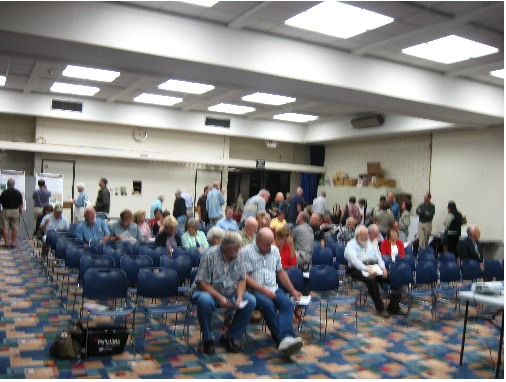
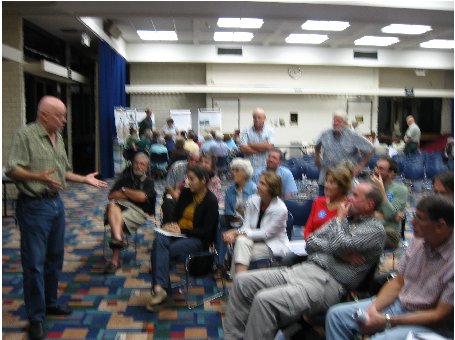
 -- Picture of the forum's attendees
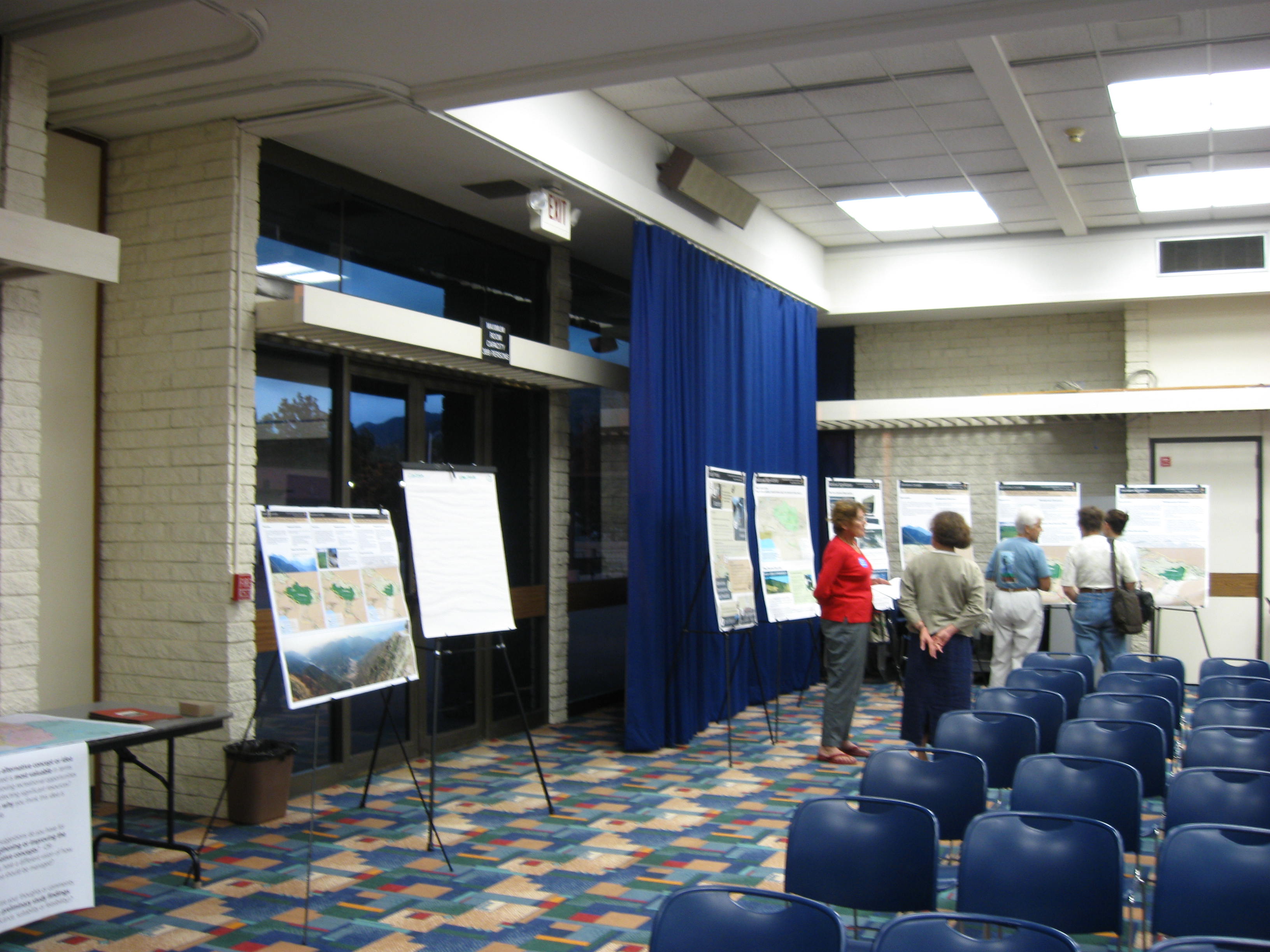 -- Picture of the forum's attendees
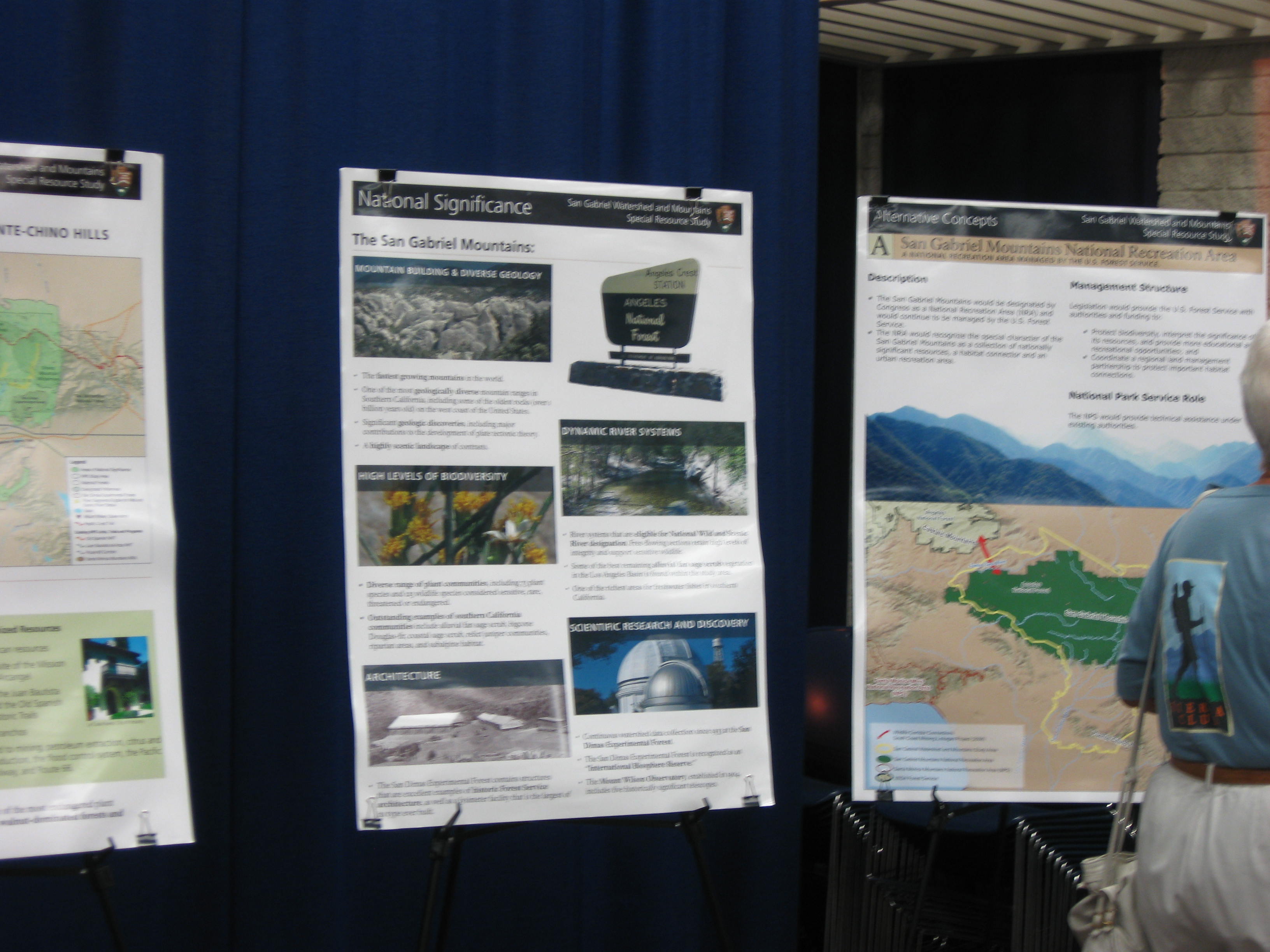 -- Picture of the forum's attendees
 -- Picture of the forum's attendees
 -- Picture of the forum's attendees
 -- Picture of the forum's attendees
 -- Picture of the forum's attendees
 -- Notes written on paper
 -- Notes written on paper
 -- Notes written on paper
 -- Notes written on paper
 -- A copy of this write up in Microsoft Word Document format
This web site is not operated or maintained by the US Forest Service, and
the USFS does not have any responsibility for the contents of any page
provided on the http://CrystalLake.Name/ web site. Also this web site is
not connected in any way with any of the volunteer organizations that are
mentioned in various web pages, including the
San Gabriel Mountains
Trailbuilders (SGMTBs) or the
Angeles Volunteers Association
(AVA.) This web site is privately owned and operated.
Please note that information on this web page may be inaccurate.